
Episode summary:
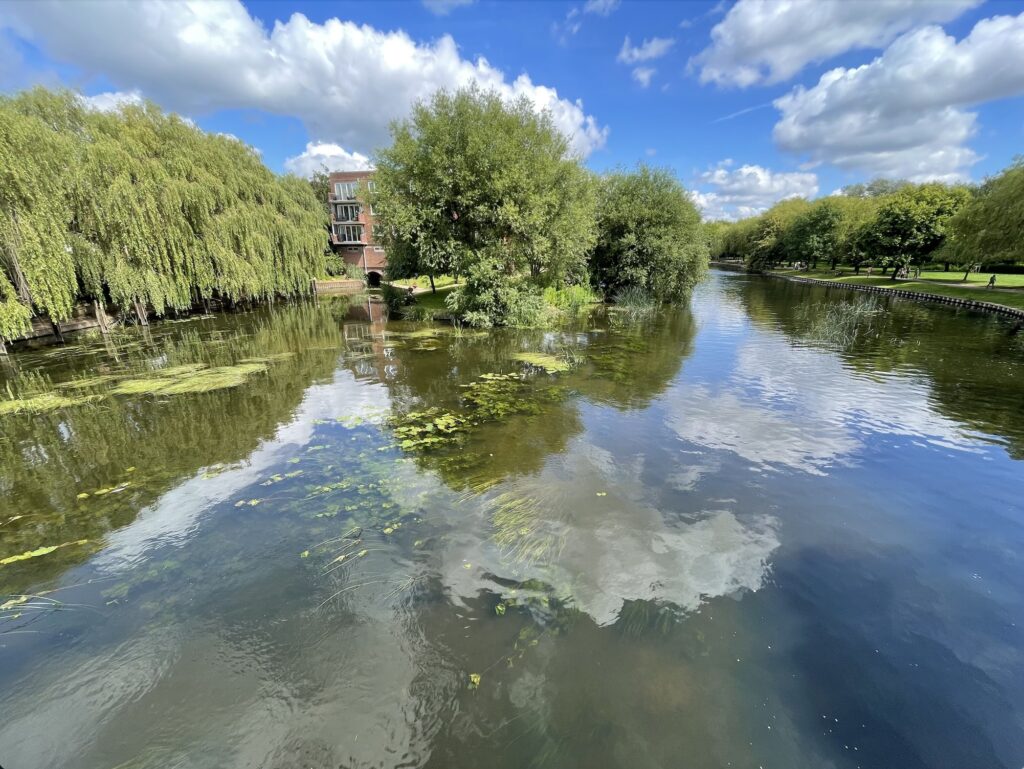
I am in the very English town of Stratford-Upon-Avon, globally famous for being the birthplace of William Shakespeare. It’s also my home town and I try to visit each May to enjoy warm, sun-drenched evenings with friends. I like to walk through the town and down to the beautiful River Avon and watch the elegant swans gliding under the willow trees in the late sunlight. There are few places as quintessentially English as Stratford.
If you are interested to know ‘is it worth visiting Stratford-upon-Avon’, ‘why is Stratford-Upon-Avon so famous’ or ‘what is the weather like in Stratford-Upon-Avon in May’, this podcast episode might give you a few clues.
Listen to a podcast about taking a slow stroll through Stratford-Upon-Avon on a warm May evening.
Transcript – S3 E10: A warm evening in Shakespeare’s town
This week we’re enjoying a warm summer evening in Shakespeare’s quintessentially English home town.
There are few things more comfortingly English than a late May evening in Stratford-Upon-Avon.
The antiquarian bookstores carefully return illustrated works to their protective sleeves and close up shop. The guides and guardians of the various historic Shakespearean houses farewell the last groups of tourists, dust the antique furniture and turn off the lights. The floorboards creak back into place and the ghosts come out to play.
Day-trippers trudge back to the town’s Victorian train station, carrying dripping ice-creams and tea-towel souvenirs. They half-wish they had booked a hotel for the night so they could linger longer and enjoy the evening.
In the dressing rooms of the Royal Shakespeare Theatre, actors are practicing their lines before the curtain goes up on a play while, around the corner on Sheep Street, the numerous restaurants and bistros fire up their ovens and light their lamps as the pre-theatre supper crowd bowls in.
They are some of the 2.5 million tourists that visit Stratford every year, many drawn here by the artistic legacy of Stratford’s favourite son. Shakespeare may seem to be the antithesis of today’s digital age yet his intricate tales of love, hate, jealousy, betrayal and power are still keenly relevant. There have been several attempts to turn the town into some kind of Shakespeareland theme park but all have failed. Instead, it has remained largely authentic.
Strolling through the warm-walled country town
Many buildings have been beautifully preserved. The oak panels and warped beams of the White Swan Hotel, for example, really have been there for more than 450 years, and the town’s grammar school is still turning out well-read pupils as it has since – if you can believe it – 1295. Shakespeare was one of them. He was taught Latin and Rhetoric in a room above what is now the Guildhall, on Church Street. The place stands opposite the Indigo Hotel and the corner block where Shakespeare’s home New Place once stood. He bought it when he returned in triumph to Stratford after a successful career in London. He died there too.
As well as Stratford being Shakespeare’s hometown, it’s mine too and I try to get back here each May for balmy, sun-drenched evenings such as this one. Anyone who has experienced England’s fickle and often cruel weather will know just how valuable even one warm, dry summer evening is.
I’m heading, eventually, for the River Avon but I’m in no hurry. The sun won’t set until after 9pm and it’s that wonderful promise of late light that makes this time of year here so special. In winter, people hold their coats to their throats to keep out the cold and rain, and hurry home through the gloom which envelops everything by 4pm. But now, in May, such discomfort and urgency have gone and rather than battening down the hatches against nature, we gleefully run towards it.
Across a cloudless sky a descending peal of bells rings out, courtesy of the ringers at Holy Trinity Church who are beginning their evening practice. With this uplifting accompaniment I run my hands along warm brick walls and the cool bark of lime trees in the Old Town neighbourhood. I spot two old tramps sitting in the memorial garden near the church, letting the sun warm the whiskers of their grey beards. Something has amused them and they laugh together with the gravelly rasps of people who have spent a lifetime outdoors, braving the elements. I don’t know where they are sleeping tonight, or what they might eat – maybe they don’t know either – but something tells me they are – at least in this moment – relatively content.
The lazy river
Down by the River Avon at the back of the church, light is dappling through the branches of the plane trees and the wooden benches are still comfortably warm from the sunny afternoon. This is a great spot to watch the river as it flows slowly towards the weirs at Lucy’s Mill and then on, westwards, making its steady, stately way towards its confluence with the Severn at Tewkesbury and its final destination, the Bristol Channel.
The first cool evening breezes carry the unmistakably earthy, silty scent of summer river water as it cascades over the steps of the weirs. Into view sails one of the Avon’s resident flock of swans, snow-white and graceful as can be and slipping through the magnificent curtain of a weeping willow just a few feet away from me. It ducks its head and neck under the water and re-emerges with green river grass comically wrapped around its beak. I can’t tell if it’s hunting for food or just doing this for fun.
I watch until it leaves my view and then walk on through the Avonbank Gardens. Plays are sometimes performed here on a makeshift stage in the open air… but not today. Instead I see just the broad spread of lush, green grass, populated only by two teenaged girls, lying in the setting sun and entwined in each other’s arms… intoxicated by a summer of young love.
An idyllic evening
I find a seat in the beer garden of a riverside pub called the Dirty Duck where a couple of theatre friends are waiting for me. The pub has been a favourite of actors for decades and their signed photographs still line the wood-panelled walls. We sip beer and wonder: if idyllic evenings like this were guaranteed here in the UK, as they are in, say, the South of France, would we notice them and appreciate them as much?
We agree that although this evening may be a temporary respite from the world – a stolen season, if you like, with delicious beer and fragrant summer breezes – everything right here right now seems right with the world.
© copyright Matthew Brace