
Episode summary:
I re-visited an old friend, a large ‘spirit’ horse carved out of the chalk downlands of southern England. It is unlike any other chalk figure ever created. It is beautifully animated, galloping free across the landscape. It is also ancient, dating from more than 2,500 years ago.
If you are wondering ‘what is the white horse at Uffington’, ‘what is the story behind the white horse’ or ‘what does the Uffington White Horse mean’, this podcast episode might give you a few pointers.
Listen to a podcast about meeting the wonderful, mystical White Horse of Uffington.
Transcript – S4 E4: Meeting a mystical ‘spirit’ horse
This week we’re meeting a rather wonderful British horse.
I’m lying on cool grass on a warm English summer day. A skylark hovers in the sky above me, singing its heart out, ascending slowly and then free-falling back down. They nest around here and despite those nests being on the ground, the population seems to be thriving.
It’s late afternoon and the crowds of tourists have gone, leaving just a few people who, like me, are embracing the calm and comfort of the scene.
Nearby is the Ridgeway, one of the UK’s long-distance National Trails, that stretches east–west from the Chiltern Hills north of London to the spiritual stone circle at Avebury in Wiltshire. It is Britain’s oldest road, an ancient track dating back 5,000 years.
In front of me is a broad white line of chalk. I stroke the grass verge next to it, as if petting a cat or dog. In this case, it’s a horse…. but no ordinary horse.
The most spectacular British chalk figure
This line of chalk is the top of the rectangular head of the White Horse of Uffington, for my money the most beautiful and inspirational of Britain’s many chalk hill figures. There are quite a few other chalk horses but none comes close to the artistic mastery and wonder of this one.
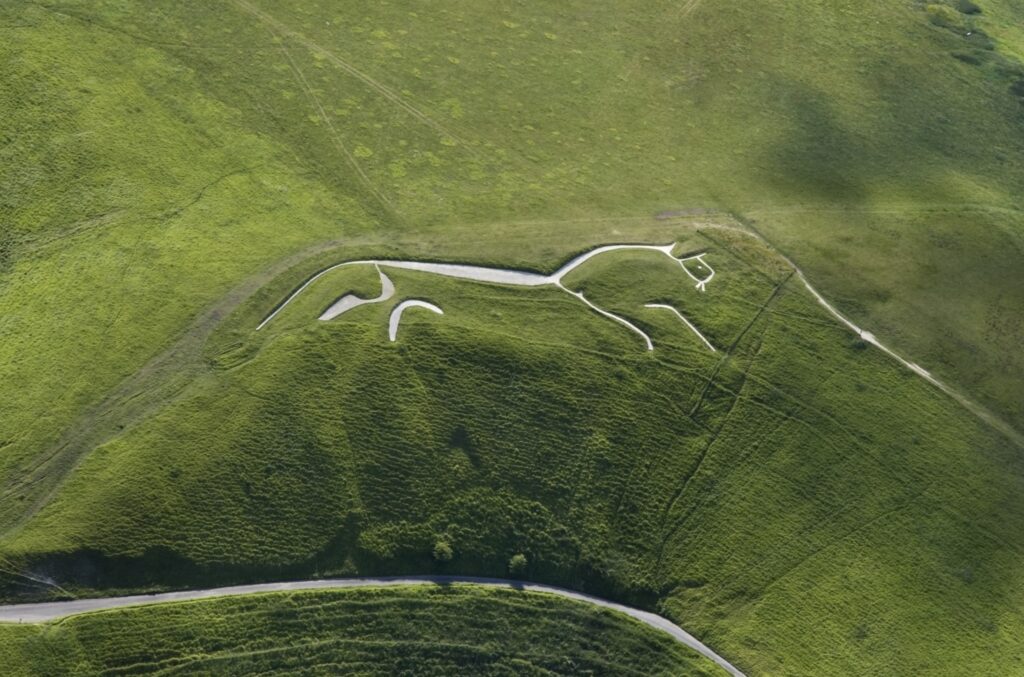
It’s hard to see from the ground but aerial photos reveal a remarkable artwork. It’s lithe, skeletal frame and disjointed legs are a mix of abstract, minimalism and surrealism yet this figure was scratched out of the hillside more than 2,500 years before any of those art movements were even dreamt of, for it dates back to the late Bronze Age or early Iron Age and is by far the oldest of the UK’s chalk horses.
It’s both simple and sophisticated, a prehistoric stick drawing essentially but with such flow and grace that you’d think it was an early sketch by Giacometti for a pipe-cleaner-thin bronze statue he never got around to casting.
From its head, a single continuous chalk line runs hundreds of feet across the hill, delineating the creature’s neck, back and tail. It even has pointy ears, just like an alert horse, and a single eye – exactly as we see a horse’s eye from one side. Legend has it that if you stand on the head and turn around three times near the eye, good luck will come your way.
One of its rear legs is fatter in parts where calf muscles are on a real horse, while the other one is little more than a chalk boomerang … yet there’s no doubt what it represents.
One of its front legs is thinner and looks as if it has been drawn in the shadow of its twin, only showing part of the limb. And it’s bent, just the way a real running horse’s leg is.
Ancient artists ahead of their time
Whoever the artists were, they knew exactly how horses looked and how they moved in flight. The accuracy is uncanny. There are plenty of paintings of racehorses from the last 50 or 100 years that are nowhere near as accurate, and they may well have been sketched with the advantage of photographs or even TV footage.
The White Horse artists were doubly skilled because they managed – incredibly – to reproduce this movement accurately and thrillingly not on a canvas but a wild, windswept hillside. Even if they scratched it out on a day as idyllic as this one, it’s still an amazing feat.
You can see this beauty from 20-odd miles away over the valley but still only obliquely. Its creators never saw it from the air. They never saw just how accurate their amazing artwork is, or how animated… it really does look like a spirit horse, galloping free across the downs.
A sense of peace and respite
I’ve been coming to stroke the head of the White Horse of Uffington for years and I still will not be surprised if I turn up here one day and it’s cantered off somewhere. But why is it here? Was it reverence to a horse god of some sort? Was it connected to the adjacent Uffington Castle hillfort, which is about the same age? Was it a symbol of defiance or threat? “Come near us and we’ll set the spirit horses on you!”
In all the years I have worshipped this horse, I have never bothered to find out, which is unusual for an inquisitive journalist. The truth is I don’t care. The fact that it is here, that it is beautiful, that I can visit it in rain or shine and stroke its head, and that it and the land around it is protected as a national monument is all that matters to me.
The fact that it brings me peace and some respite from the world is all I need to know.
© copyright Matthew Brace