

Episode summary:
I went back to my hometown of Stratford-Upon-Avon to search for midsummer spirits in an enchanted English woodland.
If you are wondering ‘why is Stratford-Upon-Avon so famous’, ‘what was Shakespeare’s A Midsummer Night’s Dream play inspired by’ and ‘what are some good hikes on the Welcombe Hills’, this episode might give you some clues.
Listen to a podcast about a very literary nature ramble in Shakespeare’s footsteps.
Transcript – S4 E8: Fairytale nature walk in Bard country
This week we’re searching for midsummer fairies in an enchanted English woodland.
Most of us are lucky enough to have a special place. It could be a hill or a river. Could even be a pub or a hotel. One friend of mine has a particular penchant for a car park. Whatever and wherever it is, it’s a place that triggers nothing but good memories.
Mine is a small deciduous wood in the Welcombe Hills nature reserve just outside the English town of Stratford-upon-Avon. I was born and grew up here, not in the wood obviously but in the town. However, now I come to think of it, I did pretty much grow up in this wood. I spent long summer days here with childhood friends, playing complicated games that involved rescuing people from dragons and ogres. We dared each other to eat berries that we knew we probably shouldn’t but we never got sick. The worst that happened to us was the odd scratch from a hawthorn bush.
Magic in the woods
I spent my adolescence here too, holding hands with girlfriends on frosty winter walks, quoting metaphysical poems to each other and hoping the feelings lasted forever. I have hugged and chatted to the big oak trees and I make an annual pilgrimage to commune with my own special tree – a Scots Pine that sits on a ridge with a great view over the floodplain of the River Avon. But there’s something more here… a magic.
It’s subtle… just out of reach… but here, nonetheless. I may be the only one to feel it and it may be nothing more than my soul being sentimental but I often feel I am not completely alone here. It’s not a scary feeling; in fact, it’s quite comforting but with just a hint of transcendental mystery.
The feeling is particularly strong at dusk on a summer evening, when the last birds are flitting home to bed and the earth is giving off its rich, musty scent.
A white witch I once knew told me about the sometimes paper-thin veil between our world and the spirit world. She was not surprised one bit that I had such powerful feelings in this wood, as many – she told me – are, indeed, enchanted.
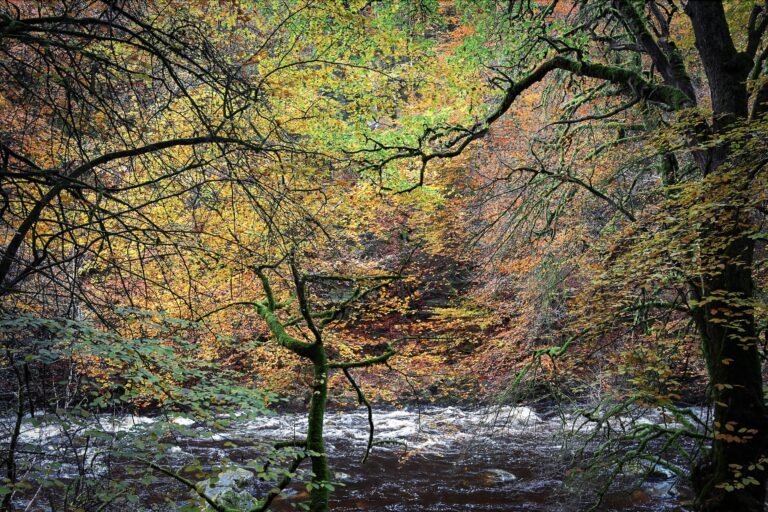
It’s May now – the height of spring – and the wood is alive with flora and fauna. At the top of the wood are three or four mighty oaks, hundreds of years old judging by the girth of their trunks. I take the path that winds past them and then descends into the thicker, scrappier sections where I find birch, hazel and hawthorn. There are some beech trees in this wood too and in autumn they blanket the floor with rust-red leaves.
A steeper path leads down to a wooden stile at the southern edge of the wood and I take that sometimes but it’s where my childhood ogres used to live and it’s funny how I still think there might be one hanging out down there behind a blackberry bush.
Nature, living in harmony
Today, I am taking a gentler path west, which gets me to a line of spectacular horse-chestnut trees. They are in full leaf and their branches are weighed down with their big characteristic white flowers, or ‘candles’ as they are known.
I stop to take some photos and hear a chiffchaff’s simple and instantly recognisable tune and then two robins calling to one another across the treetops with far more complex, lyrical collections of notes. In the background, barely audible and deep in the wood is a woodpecker drumming away at a tree trunk.
I imagine these creatures living in harmony with the wood spirits, all working to maintain the natural order of things as much as possible.
My fanciful ‘Midsummer Night’s Dream’ theory
All this natural beauty and wonder led me – some years back now – to devise a theory. This wood lies less than a mile outside Stratford. It seems highly unlikely to me that the teenaged budding Bard would not have walked through it. There would have been a lot more of it back in Shakespeare’s youth. In fact the entire Welcombe Hills would almost certainly have been wooded, part of the vast Forest of Arden, which covered much of the English Midlands.
Now there’s an awful lot we don’t know about Shakespeare but one thing we do know is his ability to paint vivid literary pictures. We also know A Midsummer Night’s Dream was one of his earliest plays and by far the most florid and fantastical, laced with fairies and haunted groves. It has all the hallmarks of a youth or adolescent feeling the joys and wonders of nature possibly for the first time.
If I get welcome goosebumps in this wood – and I am, shall we say, a fair few summers past my adolescence – and it inspires me to imagine another world existing next to our own, then how much easier would it have been for the young, impressionable Shakespeare, his mind bursting with ideas and stories to tell.
We’ll never know, of course, whether this wood is the inspiration for the fairy kingdom in A Midsummer Night’s Dream but I choose to believe it is.
If you get here one day, I hope you do too.
© copyright Matthew Brace