
Episode summary:
I spent a fascinating day with a local Aboriginal man in a secret part of the stunning Flinders Ranges in South Australia. He opened my eyes to the wonders of ancient rock art – 27,000-year-old messages and stories that his ancestors etched on sandstone boulders. This is a secret site and not on the main tourist trail, which made it all the more special. He also taught me how his ancestors lived off the land, using native plants for everything from making rope to curing stomach ache. If you’re wondering ‘where is rock art found in Australia’ and ‘where is the best place to see Aboriginal rock art’, add the Flinders Ranges to your list.
Listen to a podcast about seeing ancient Aboriginal rock art in the Australian Outback.
Transcript – S1 E7: Time travelling in the Australian Outback
This week, we’re time travelling in the Australian outback.
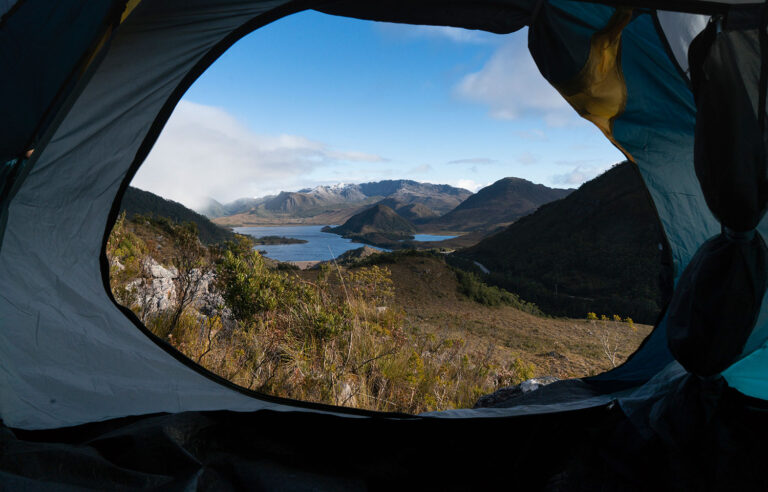
The Flinders Ranges Way curves pleasingly as it heads north. It banks around low hills, passes through pine scrubland and crests gentle ridges. Towering eucalypt trees line the route, some standing solo, others in small clumps. There are views at every turn – of rolling hills and the Flinders Ranges Mountains. It’s a lovely drive. The road runs close to Wilpena Pound, which looks like an ancient and much-weathered volcano but is in fact a synclinal basin caused by the ancient sea floor being uplifted, folded and then tilted over millennia.
Secret meeting
But on this warm, sun-drenched November day, I don’t have much time for sightseeing because I have an appointment with a local Aboriginal man, Kristian Coulthard. He’s given me only very basic meeting instructions, namely a gravelly lay-by somewhere north of Dingley Dell campground. No coordinates, no Google Map reference. Instead, by email a few days before, he told me to look for his pick-up truck or ‘ute’ as the Aussies call them, with the orange sticker advertising his tour business – Wadna. It’s all a bit clandestine, but it’s part of Kristian’s commitment to keeping this place secret.
There’s nobody at the Dingley Dell campground, just a large forlorn patch of ochre earth baking in the sun, waiting for visitors. And I realise I’ve not seen anyone else on the road for some time. The Flinders Ranges Way ends in a small settlement called Blinman, about a half-hour drive north of Dingley Dell. From there, it’s four-wheel-drive dirt roads only, leading into the Outback. So there’s hardly a lot of what you’d call passing traffic on this road. Suddenly, beyond a clump of trees, I see Kristian, standing by his ute. I slam on the brakes and swerve off the road, onto the dirt, arriving in a cloud of dust.
He’s still wafting the dust away with his wide-brimmed Akubra hat when I greet him. You know, sometimes you meet someone and you just know you’re going to be friends. There’s an instant connection, a trust almost, an unconditional respect. I feel it the minute we shake hands, and he cracks a joke about my excellent Outback braking skills. We stroll away from the road into a scrubby landscape, a kind of rolling savanna that feels like it goes on forever.
The landscape comes alive
We haven’t gone 20 yards before Kristian stops and strokes the green fronds of a bush. He tells me how his ancestors, the Adnyamathanha people, used its leaves to make tea to soothe stomach ache. A few feet further on, he explains how another bush was used for generations to cure toothache. Adjacent to it is a bush that has tasty berries and tough twigs, perfect for hand-making string and rope. Slowly, this semi-barren landscape is coming alive.
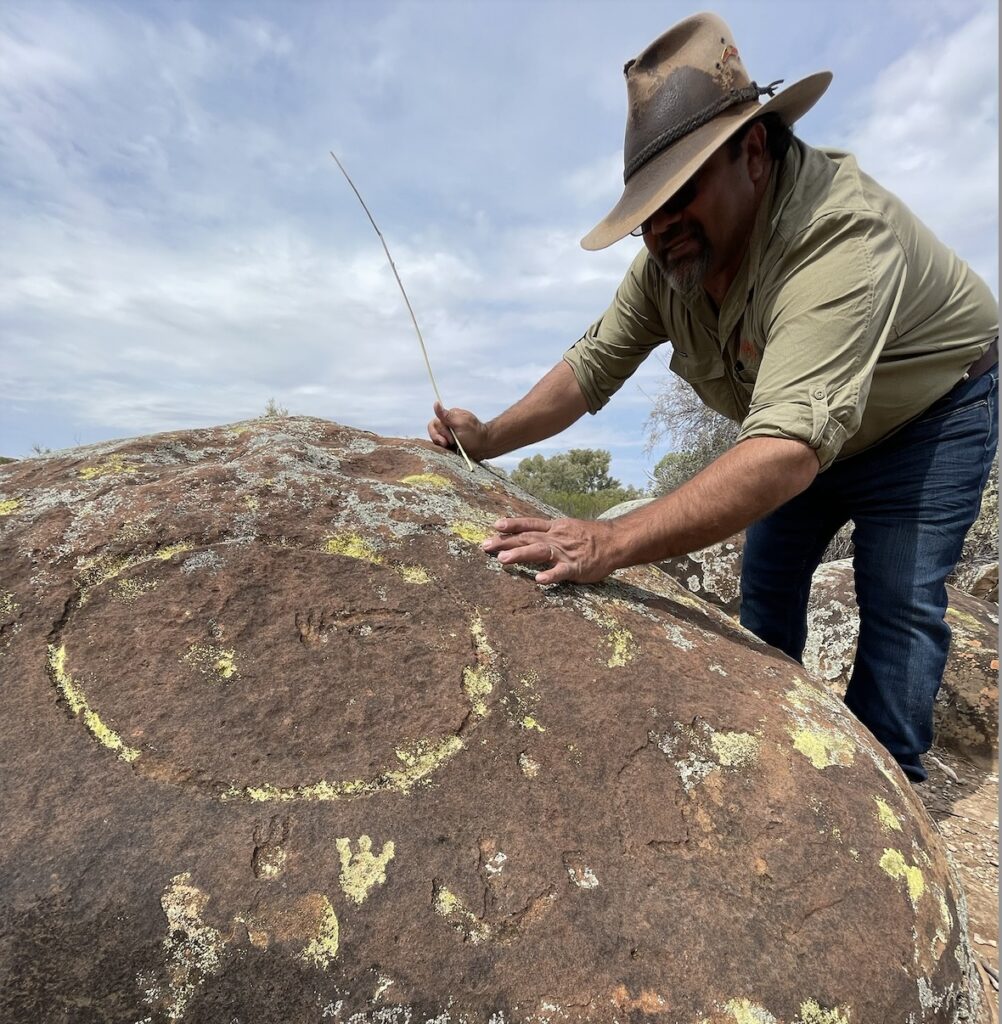
As we walk further from the road, the bushes thin out and I start to see sandstone boulders appearing. One or two at first, then a small family of them, and now we’re in a boulder field where they outnumber the bushes. They are buried in the earth so just their heads and shoulders are visible. They look deeply tanned from centuries in the sun and are well camouflaged with grey and yellow lichen. Kristian kneels next to one of them and a wry smile crosses his face. He picks up a twig and asks me: what can I see? Well, apart from rock and lichen, not much, to be honest. Oh, but hang on, is that a curved groove in the rock? Maybe a small trident shape, perhaps? I’m clutching at straws. His smile broadens as he explains, I am looking at an ancient petroglyph or rock carving. He traces the curved groove that I found with his twig and then I see that it continues under the lichen and becomes a circle.
Stories from a powerful landscape
Kristian tells me this circle is what his ancestors drew to represent a campsite. The trident I think I see is in fact a sketch of a three-toed paw print. And, almost hidden by the lichen, there’s another one a few inches away, almost parallel. Compared to the size of the campsite image, the paw prints are huge. “Yumity,” says Kristian – giant wombat! “We know those giant versions of today’s cuddly critters – megafauna – died out about 27,000 years ago. So we also know that these petroglyphs must be at least that old.”
He invites me to kneel with him to touch the warm rock. As I do so, I feel oddly connected to the land. I feel like I’m time travelling, being transported back over millennia. With just a few scratches in an old rock, Kristian’s ancient ancestors sent a message. Was it to warn others to watch out for the ferocious local Yumity? Was it to tell them that the Yumity might be good eating if they can catch it? They may only have meant the message to last for a short time, like a prehistoric Instagram post. Yet here it is, 27,000 years later, telling the same story in this powerful landscape.
© copyright Matthew Brace