
Episode summary:
I travelled with an Emirati friend to the far western region of the United Arab Emirates, on the border with Saudi Arabia, to witness the heat and majesty of the mighty Rub’ al Khali (Empty Quarter) desert. We spent most of a day climbing sand dunes and gazing at fabulous desert vistas in the height of summer and I learned from him about the powerful connection Emiratis have with their desert.
If you’re asking yourself ‘can I visit the desert in the UAE’ or ‘is it worth going to the desert in the UAE’, then this podcast might whet your appetite.
Listen to a podcast about going off-road in the desert in the United Arab Emirates.
Transcript – S1 E8: Off-road in the Rub’ al Khali desert
This week, we’re climbing a sand dune on the border of Saudi Arabia and the United Arab Emirates, and things are definitely heating up.
August in the Rub’ al Khali desert is not for the faint-hearted. It’s one of the hottest, driest and most sparsely populated places on Earth. This desert, known in English as the Empty Quarter, covers a large stretch of – well – emptiness across southern Saudi Arabia, northern Oman, northern Yemen and the western fringe of the United Arab Emirates.
This is my first visit to the UAE section, and it’s an immense privilege to see it through the eyes of a native Emirati, my friend and colleague, His Excellency Hamad Saif al-Mansouri. Hamad is tearing along the highway from Abu Dhabi in his four-wheel drive, stopping only to pray in roadside mosques and shoo away camels wandering nonchalantly across the baking-hot asphalt. We pass small towns with clumps of date palms and clutches of flat-roofed white houses, their shutters close tight against the baking heat. August is about as hot as it gets here. It’s a hypnotic heat that envelops you the second you open the car door. It’s hard to believe places can get so hot, let alone be people’s homes.
Hitting the dunes
One minute Hamad and I are chewing dates from a box on the armrest between our seats and discussing the UAE’s relationships with its neighbours in the Gulf region. The next, our horizon has turned from flat dirt with occasional settlements to the white beige of sandy slopes. We’re hitting the dunes. This, Hamad tells me, is the eastern edge of the Rub’ al-Khali. From here the vast sand seas spread all the way to Najran in southwestern Saudi Arabia, near the Yemeni border, more than 600 miles, or 1,000 kilometres.
A bit further on, Hamad breaks off our conversation. He’s slowing down, studying the dunes and the road markers. Suddenly he dives off the road and we’re on soft sand. My adrenaline starts pumping. We’re in the Rub’ al Khali. I love deserts and I’m now in one of the world’s most spectacular. Dunes move over the years, of course, but Hamad knows this land as well as I know London’s back streets, from Marble Arch to Leicester Square in a blackout on a moonless night. Every now and then he brings the four wheel drive to a halt, gets out and reads the landscape. He’s relying on his memory and the desert navigation skills he inherited from his Bedouin ancestors. When in doubt, he gives me a cheeky grin and checks the car’s sat-nav. “The old and the new,” he says, “we need both here.”
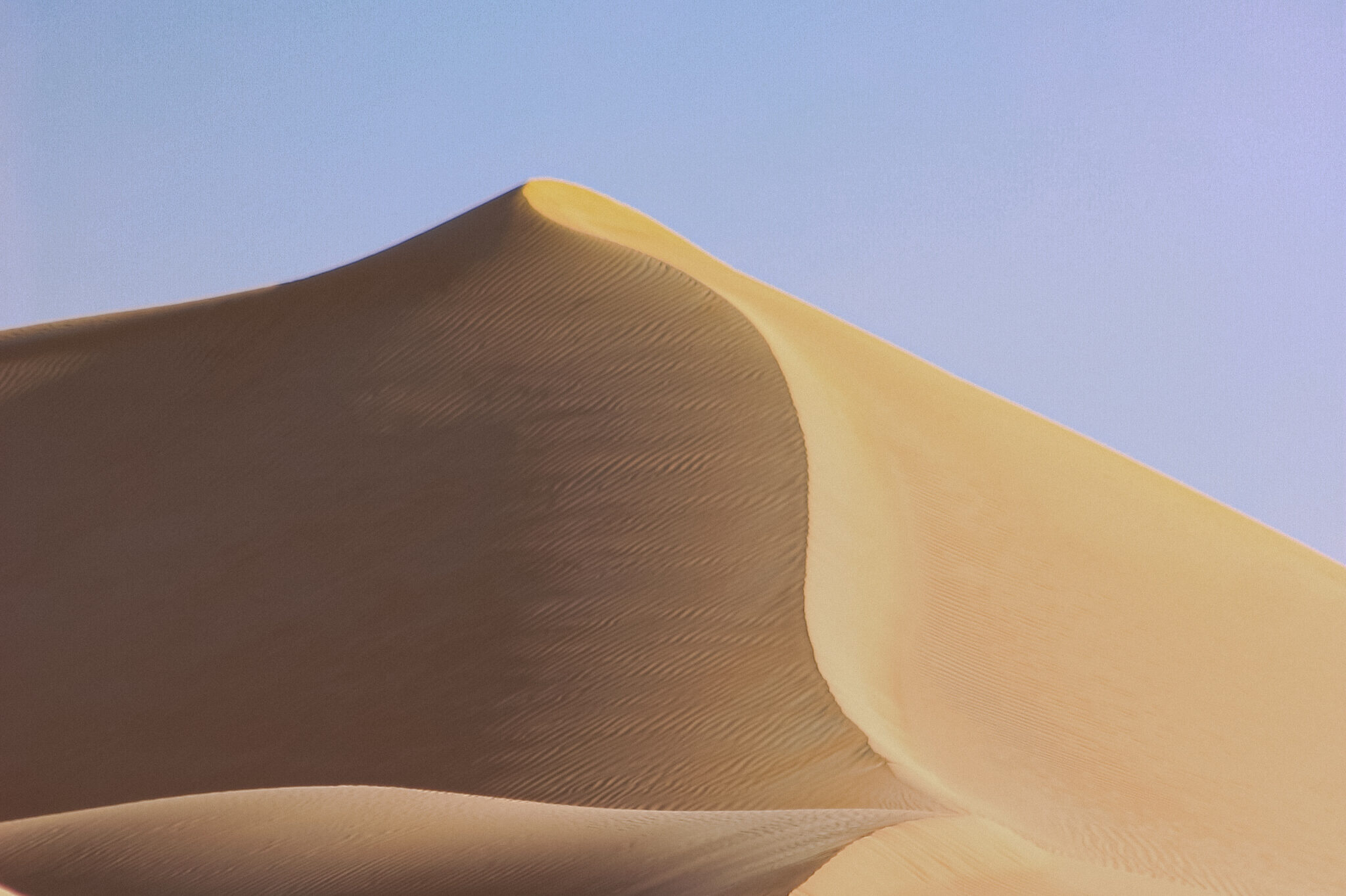
After an hour or two of sand driving, we leave the car and climb a perfectly sculpted dune. We clamber up, slipping on the loose surface sand and dropping to our hands and knees to negotiate the last section. It’s worth the effort. From the summit, we can see for miles out towards the Saudi border and into the heat haze beyond where the Empty Quarter becomes seriously empty. The heat now is oven-like and there’s just the lightest of breezes up here. More of a sigh, really, that barely lifts a hair on my head. We trace the peaks and troughs of endless dunes that stretch to the horizon. The sky is an off-white colour at its base, a dusty cornflower higher up and a rich azure right above my head.
Desert connection
Hamad scans the scene silently, reverentially. Despite the great wealth and luxuries that Emiratis have acquired through the UAE’s decades of oil and gas expansion, it’s the simplicity of the desert and its connection to their recent nomadic past that really moves them. Hamad has, temporarily, come home. From the top of the dune, we look into a breathless sand canyon where a camel and her calf are making for a sliver of shade under a ridge. Hamad watches them, remembering similar scenes from his childhood. I am reminded of passages from Arabian Sands, explorer Wilfred Thesiger’s evocative travel narrative about crossing the Empty Quarter and relying on the kindness and knowledge of local Bedouin for his survival. I realise my survival, right now, is in Hamad’s hands and I trust him implicitly. Alone, I would surely die out here of heat stroke, starvation, dehydration or a terrifying combination of all three.
The heat is like nothing I’ve felt before, greater even than my July drive through California’s Death Valley two years ago. Yet it’s oddly comforting too. It’s having a similar effect on me as a Finnish sauna. I feel my brow unfurrowing, my muscles losing their tension. Of course, if I had to trek back to the road, or even change a tyre, it would be a different story. But in this moment, sitting on the top of Hamad’s dune, I am utterly relaxed. The lack of humidity is the key. The unbearable stickiness that plagues the coastal cities of Abu Dhabi and Dubai during summer can out-soak Miami. But here, the heat is crystalline.
A few hours later, after sunset and supper, we sit in the moonlight by our campfire, sipping cardamom-infused Arabic coffee, eating yet more dates and swapping stories. I let the warm sand run through my fingers and feel the spirit of the Rub’ al Khali all around me.
© copyright Matthew Brace