
Episode summary:
I spent an hour with a troop of kangaroos in a nature reserve in Australia’s capital city, Canberra. The city is nicknamed the Bush Capital, because walking or cycling just a few minutes from the city centre brings you into nature. Most of the kangaroos were placid but one male decided I might be getting a little too close and gave me the old “watch it mate” hard stare.
If you’re wondering ‘where can I see kangaroos in Canberra’, ‘which Australian cities tend to be frequented by kangaroos’ or ‘are kangaroos dangerous’, this episode might give you some answers.
Listen to a podcast about spending an hour with Canberra’s capital kangaroos.
Transcript – S5 E2: Meet the capital kangaroos
This week we’re getting almost too close to one of Australia’s iconic animals in the nation’s capital, Canberra.
The thing with kangaroos is you’re never quite sure what they’re going to do next. Mostly they look pretty docile, squatting on their long L-shaped legs and munching grass all day long. But every now and then they stand up, stretch to their often quite formidable height and start furiously scratching at their chest and belly, creating mini dust-storms of fur and flies.
If two males decide to scratch at the same time and are standing close enough to each other, it can kick off a scrap. Then the fur really flies.
So, it is with some trepidation that I walk into the low, flat clearing of Stirling Park near Lake Burley-Griffin. It’s a late-winter afternoon and there is a troop of 30 or 40 kangaroos hanging out here, having a feed. There are females, some with wriggling joeys in the pouch. And there are some very, very large and slightly terrifying males.
Exuberant eyelashes
There are, I am reliably informed, a lot more kangaroos in this reserve but they don’t always flock together in one group. Instead, they are spread out among the various clumps of eucalypt and pine woodland. Others lollop through the sandy scrub near to a walking trail which leads down to the Canberra Yacht Club. I know this because I nearly bumped into one yesterday while on a 5km run. I was on the run, not the kangaroos, although – come to think of it – they might have been too. I am sure they cover way more ground than that every day.
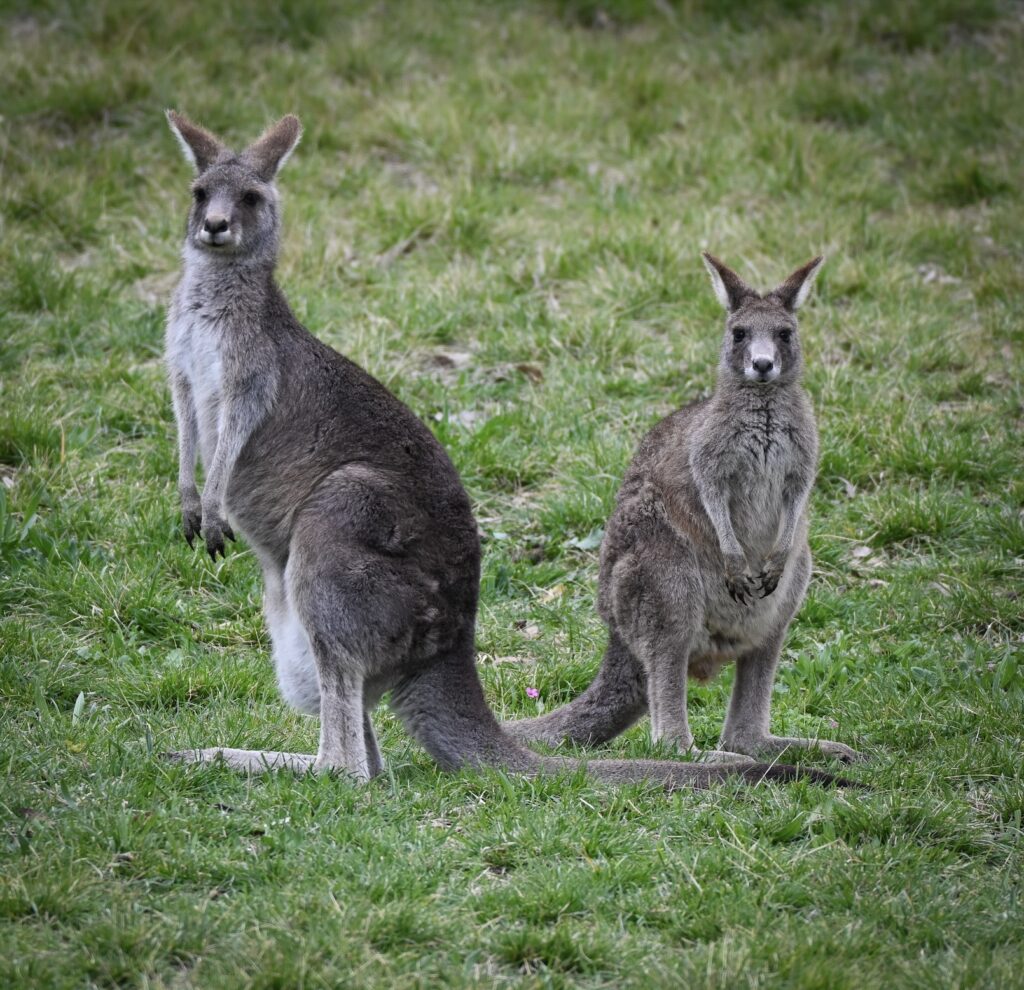
The females and little ones really are things of beauty. They have long elegant faces and big, liquid-black eyes with exuberant eyelashes. Their fur is a charcoal grey on their backs but a lighter ash colour on their chests. The joeys in front of me are doing exactly what kids should do: mucking about. One scrambles out of its mother’s pouch and flops to the ground, hops a step or two, turns and almost dives back inside, poking its head out again to see if anyone saw its performance and is applauding. I did and I am, saying under my breath: “do it again, do it again.”
These lovely creatures are also just so iconic. It’s probably not such a big deal for Aussies, a lot of whom must have grown up with kangaroos all over the place, but for a blow-in like me (even one who has lived here for many years) it’s still amazing to stand just a few feet away from them.
Canberra is a great place to get close to kangaroos with little effort. Seeing them so close to the city centre in Sydney or Melbourne never happens but here in Australia’s capital – the Bush Capital as they call it due to its proximity to national parks and reserves – you only have to take a 10- or 15-minute walk out of the CBD and you’ll spot some.
Kangaroo hard stare
The troop registers my presence but this is a well-walked track so they are used to people. They couldn’t care less. Well, apart from one. A large male hops a bit closer and stops, staring at me. He has moved between me and the females – and rears up to what must be nearly 7ft tall; more than 2 metres. These are Eastern Grey kangaroos, not the biggest subspecies – those are Red Kangaroos that live mainly in the Outback – but certainly big enough when they are less than two hops away from you.
The usually cute expression these creatures have has left this male’s face and been replaced with what I can only describe as a look that says: “come on then, mate, have a go, if you think you’re hard enough.” I’ve seen this look before, but on a human face in a pub, not on an animal out here in nature.
I must confess, it’s quite threatening, quiet alarming. I back away… very slowly. One tentative step at a time. Those powerful legs and vicious claws could potentially eviscerate me… and that’s never a good look.
In the background the females are still grazing and the joeys still mucking about but my focus is on the Alpha male here. His ears twitch as he wafts away a fly and his mouth opens slightly. I sense he is poised to bound towards me so I continue my retreat.
All is well
I am back on the main path now and that seems to calm him down a bit. He turns away to watch some other people walking across the reserve. All is well again. I am safe but – more importantly – the troop is safe too.
I have brought my camera with me, and my telephoto lens, and I walk over to some fallen logs and spend a very happy hour watching and photographing the little ones gambolling over the ground, bumping into things, chewing on grass and then hopping back into their long-suffering mother’s pouch for a warm snooze.
I have experienced many of Australia’s landscapes and a lot of them are among the harshest and most unforgiving on Earth. For once, it’s nice to be somewhere bucolic and gentle.