
Episode summary:
I am on a long Pacific Ocean beach in Costa Rica watching a truly monumental natural phenomenon. Hundreds of thousands of Olive Ridley turtles are hauling themselves out of the waves under a bright moon and dragging their bodies up the beach to lay their precious eggs. This rarely seen biological phenomenon is known as an arribada and I am lucky enough to witness one.
If you are wondering ‘what is an arribada of turtles’, ‘how many turtles participate in an arribada’ or ‘where can I see turtles in Costa Rica’, this podcast episode might help give you some answers.
Listen to a podcast about watching the truly monumental natural phenomenon of a turtle arribada.
Transcript – S3 E8: The great Costa Rica turtle race
This week we are witnessing a wonderful and thrilling natural phenomenon on a beach in Latin America.
Nature is not always on time. Just ask any BBC Natural History Unit camera crew. You can’t rush it. You shouldn’t rush it. It has worked to its own timeframes way before we humans came along.
Experiencing it often involves a lot of waiting. So, here I am, waiting on a volcanic sand beach on the Pacific Coast of Costa Rica. I am actually sitting here with a BBC Natural History Unit camera crew.
It’s close to midnight on Night Three of a wildlife vigil. We’ve got used to the little sand flies. Our eyes are now well accustomed to the dark. And we have realised that in the early hours on a tropical Pacific beach it can actually get a little cool.
Then, suddenly, an eagle-eyed member of the crew sees it. A shape bobbing on the surface of the water maybe 25 metres offshore. A dome!
It glistens in the light of the waning moon and disappears, replaced two seconds later by a thin periscope-like thing. We all reach for our binoculars. It’s a head. It’s gone again but another one emerges a few metres to the right, then another.
Then they all disappear and we wonder if we are in for another night of inaction.
The alien landing begins
But no… this time, several heads appear at once. This is a lot more activity than we have seen on previous nights. This could be it. The shiny domes appear once more. One, two, three, then five, 10. Closer to shore this time.
The moon is brilliant in the clear late-November sky and reflects off the domes, making them look like shiny submerged rocks rising to the surface and jostling gently together.
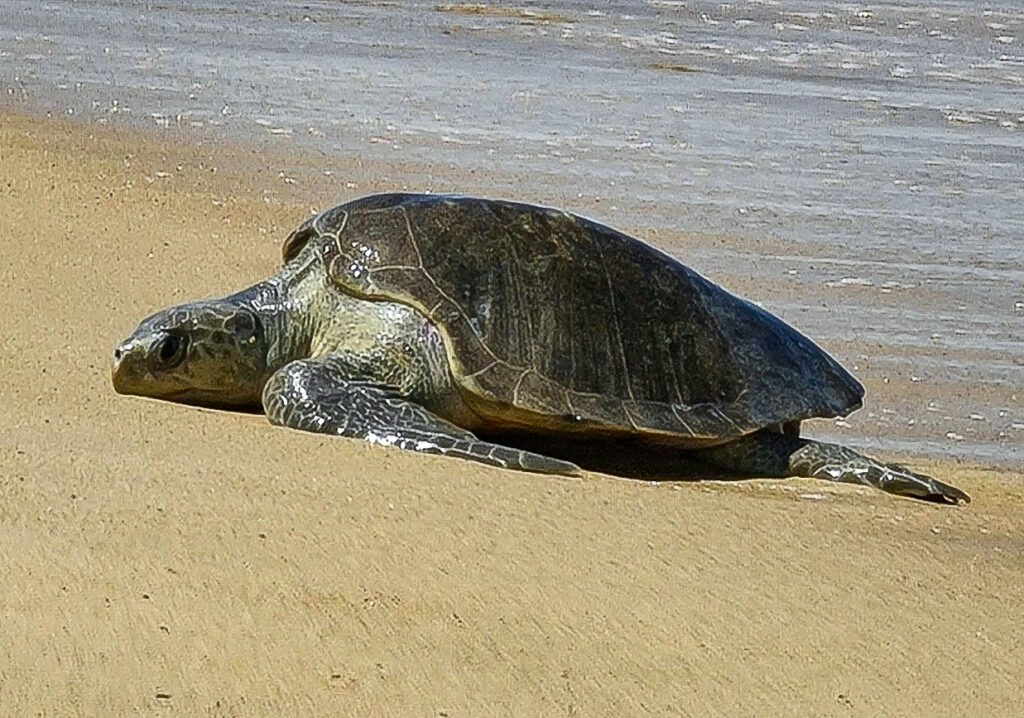
But these are not rocks. These are the shells of Olive Ridley turtles. They are all females and they are starting a rarely seen biological phenomenon known as an arribada.
Prompted by some secret signal that marine biologists and naturalists are still trying to figure out, up to half a million turtles stumble out of the waves and heave themselves up this long beach. Each digs a hole in the warm sand, lays roughly 40 eggs and then covers the hole again. It is a massive effort for a creature as large and as unsuited to land as a turtle.
The first one lands, nudged onto to the sand by a wave, and begins dragging her 35kg body up the beach. It’s slow going but at least she’s got a clear run. Within a couple of hours, the beach is congested and turtles are having to push each other out of the way and even clamber over each other, so driven are they to find a nesting site and lay their eggs. Of course, once she has laid her eggs, she then has to drive against the traffic to get back to her beloved sea, where she can finally relax and float off to wherever turtles float off too… I’m not sure scientists really know that either. They have fitted turtles from Costa Rican beaches with transmitters. One swam more than 2,500 miles into the ocean before the trackers lost her signal. I’m really glad they did because these magnificent creatures need some space away from humans, some secret Shangri-La to hide in.
The glorious mystery of nature
The first turtle finds a spot quite near us. My colleagues are filming like crazy but I am merely watching this miracle unfolding right in front of me. I feel immensely privileged to witness such a thing and it reminds me just how complex nature is… but also how wise. We know the turtles need a waning moon, a high tide and sand warm enough to incubate their eggs but how do they know? They have no lunar timetables, no tide markers, no sand thermometers. And when they do know, how do they – en masse – decide “OK girls, tonight is the night, let’s do this”.
This glorious mystery thrills me. This secret communication and organisation gives me faith that nature always has it right. Its knack of balancing everything so carefully so biodiversity is maintained gives me hope for the future.
My female turtle has laid her eggs, covered them and patted them down. She is exhausted but now has to drag herself back through the onslaught to the ocean.
All around her come wave after wave of her sisters. The entire beach, for as far as we can see (and I’d say we’re talking a good kilometre here), is moving.
My female, one of the evening’s pioneers, is lost in the crowd. I know she’ll make it back to the waves; this is not her first rodeo. But I wish her well anyway and thank her for allowing me to witness what will undoubtedly be one of the most wonderful and thrilling nature experiences of my life.
© copyright Matthew Brace