
Episode summary:
I am at Adventure Bay on Bruny Island, off Tasmania, watching a super-cute white wallaby feeding at the edge of a car park. This very rare animal is only found here, where they are protected. If you are asking yourself ‘how rare are albino wallabies’, ‘where are the white wallabies in Tasmania’, ‘where can I see an albino wallaby’ or ‘what can you do in Adventure Bay, Tasmania’, this podcast episode can help.
Listen to a podcast about finding super-cute white wallabies in Tasmania.
Transcript – S3 E7: Meeting a very rare wallaby
This week we’re enjoying a perfect evening watching a very rare creature on a beautiful island off the south-east coast of Tasmania.
My arms ache. My thighs too. And – even though I am on dry land now – I feel like I am still moving slightly, cresting the gentle swells of the South Pacific ocean. I’ve been kayaking on an idyllic late summer day in Tasmania and am basking in that post-paddle glow, full of memories of the beauty and serenity of the experience. I’ll be sore tomorrow but I don’t care – it will be worth every stroke.
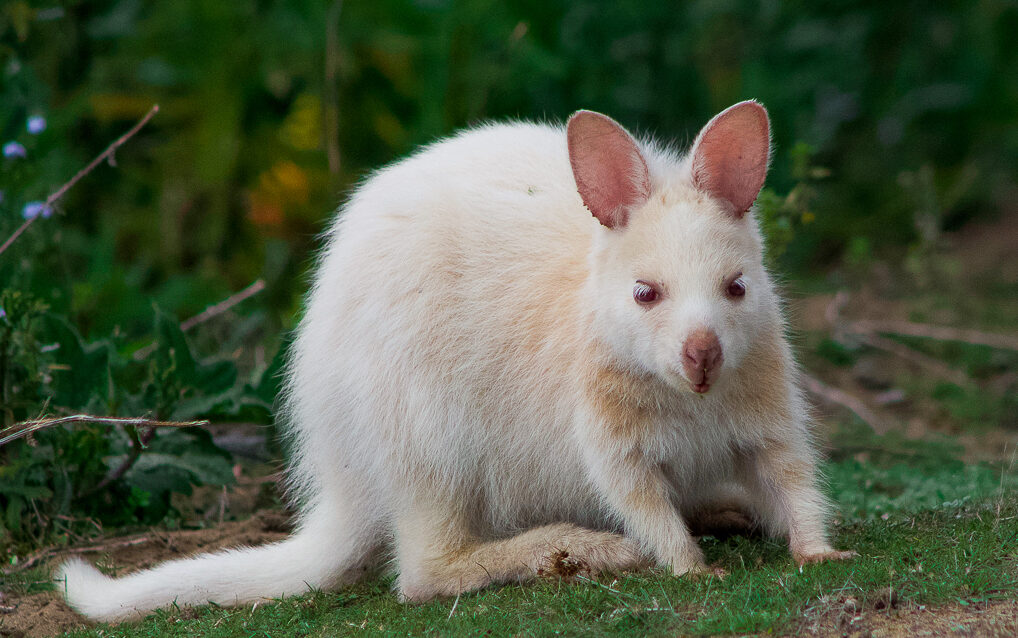
I am about to head back to my guesthouse for a well-deserved glass of chilled Tasmanian Riesling but something catches my eye. It’s moving in the bushes at the edge of the car park. I can’t see what it is behind the foliage but then I get a clue: two ears pop up behind some leaves. The ears are pink on the inside and the edges are a light cream colour.
The ears disappear again and a few seconds later their owner comes out of hiding.
A rare find
It’s a wallaby… but no ordinary wallaby. This is one of a small population of very rare white (or albino) wallabies. It is believed to be the only wild population in the world, so to see them you’ll need to get yourselves all the way down here… to Adventure Bay on Bruny Island off the south-east coast of Tasmania.
However, having said that, I understand there is believed to be a small wild population in Britain too, which began after a few escaped from captivity. One of several places they have been seen is my home county of Warwickshire, in whose woods I have spent a considerable amount of time over the years but I confess I have never seen a white wallaby there.
Captain Cook anchored his ship the HMS Resolution here in Adventure Bay in January 1777 to replenish supplies during his third voyage of discovery. 11 years later Captain Bligh moored the HMS Bounty in this same spot, shortly before the famous mutiny in the South Pacific. I can’t find any mentions of white wallabies in the accounts of these voyages that I have read so – unless I missed the entry – I can only assume that these adorable creatures arrived here later… or that they kept themselves well-hidden from the British sailors.
These meek, grazing creatures are a strain of the dark-brown Bennetts wallaby, which thrives in Tasmania’s cooler climate, but these guys have pink eyes, pink noses, pink ears, bleached white eyelashes and white fur. This is a result of a rare genetic mutation – an imbalance of melanin, the pigment that determines skin colour.
Sanctuary for the white wallaby
By rights they shouldn’t exist at all – they lack the camouflage of their brown cousins so they are more obvious to predators, and they are far more at risk of skin cancer. As a blonde, fair-skinned human I can empathise with the white wallabies of Adventure Bay!
But here on Bruny Island there are far fewer predators and the sun is less intense – certainly less so than on the Australian mainland. So the white wallabies thrive here in relative peace and harmony. The population is believed to be at least 200 strong.
This one – on the edge of the car park – seems very content with its lot. It is chewing leaves and squinting in the sunlight. It finishes its mouthful and crouches down on all fours, looking straight at me. From this angle I get a great view. I can see its elongated back legs which it uses to hop, kangaroo-style, across the fields and through the forests of its island home. I can also see its almond-shaped ears, salmon-pink and twitching to waft away a couple of gnats.
Its fur is indeed white but fades to a light cream on its chest. Its tail is the whitest of all, which surprises me as I would have thought this part of its body has the most contact with earth and grass. Maybe this is one fastidiously clean wallaby.
Most striking are its Arctic white eyelashes. Anyone remember Gigi Hadid’s white lashes at the 2019 Met Gala? Well, the white wallabies of Bruny Island rocked that look first.
A revered local favourite
I rarely use the word ‘cute’ to describes animals or birds but in this case I’ll make an exception, for the white wallaby is, indeed, impossibly cute. The locals think so too and are passionate about protecting their rather special hopping neighbours. They are found in back gardens, along farm tracks and hanging around the caravan park. You might also see them along the beautiful Fluted Cape Walk, which starts and finishes in this very car park where I am sitting, busily photographing my new friend.
But soon the wallaby has had enough of posing – it turns its back to me and hops slowly into the foliage… and is gone.