
Episode summary:
I am cruising through possibly the most amazing and iconic scenery in South East Asia – the famous karst islands in Phang Nga Bay between Krabi and Phuket. I was supposed to be on a car ferry further out to sea but instead took a small fishing boat which went much close to these amazing, must-see natural rock stacks.
If you’re asking ‘what is Phang Nga Bay known for’, ‘is it worth going to Phang Nga Bay’ or ‘where was James Bond filmed in Thailand’, this podcast episode can give you a few hints.
Listen to a podcast about cruising past the famous karst islands of Phang Nga Bay at sunset.
Transcript – S3 E12: Sailing to stunning islands in Thailand
This week we’re cruising among some of the most amazing and iconic scenery in South East Asia.
I’m on Klong Sai pier near Krabi on southern Thailand’s west coast. It’s late afternoon.
There’s a car ferry that sails from here most days, crossing Phang Nga Bay to the islands of Koh Yao Noi and Koh Yao Yai. But today there’s some confusion about where it is. It’s certainly not here and there’s no sign of it on the horizon either.
So, I and a quartet of Dutch backpackers are ushered on to a longtail boat that – judging by the smell – spends more time as a fishing vessel than a ferry. Maybe it came in with a rather disappointing catch and the skipper is eager to make a little extra cash by standing in for the car ferry.
Once the engine rattles to life and we chug away from the pier, the scent of fish guts is replaced by the salty brine of the ocean and we are all awestruck by the vista ahead of us. This hour-long crossing is about to take us close to some of the most spectacular scenery not just in Thailand but in all of Asia.
Sailing to paradise
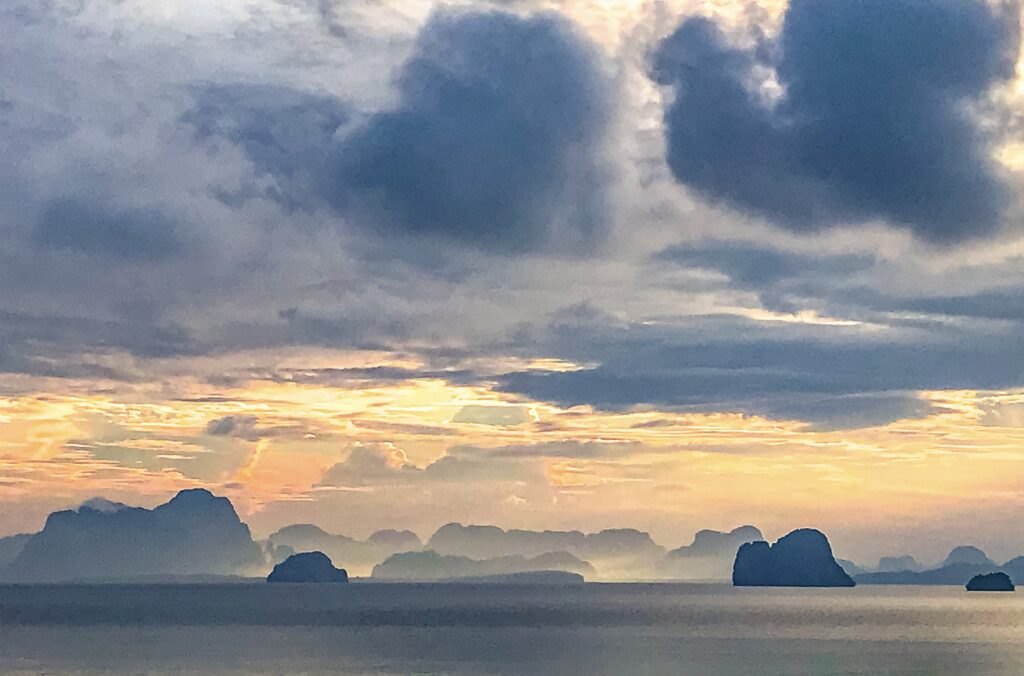
Rising from the calm waters are numerous columns of rock, some hundreds of feet tall, others much lower, barely above the waterline. Some are in groups, like herds of adult elephants forming a protective circle with their young on the inside of them, shielded from potential threats. Others are isolated, braving the elements alone.
The Dutch backpackers and I smile at each other because we seem to have timed this perfectly. It’s one of those wonderful travel moments when out of adversity comes an unplanned but memorable experience. The car ferry would probably have sailed further out to sea but we look like we are going very close to the incredible rock columns.
The sky out west looks stormy, with cumulonimbus clouds billowing up to dark purple anvils 30,000ft up in the sky. Blazing from behind these thunderheads and occupying the entire sky is a truly breathtaking sunset. There are streaks of flame-yellow and pumpkin-orange sky bordered by the crinkly edges of the bruised mauve and violet clouds. The obscured sun sends down crepuscular rays creating giant ornate fans of light that hit the water and make the waves twinkle.
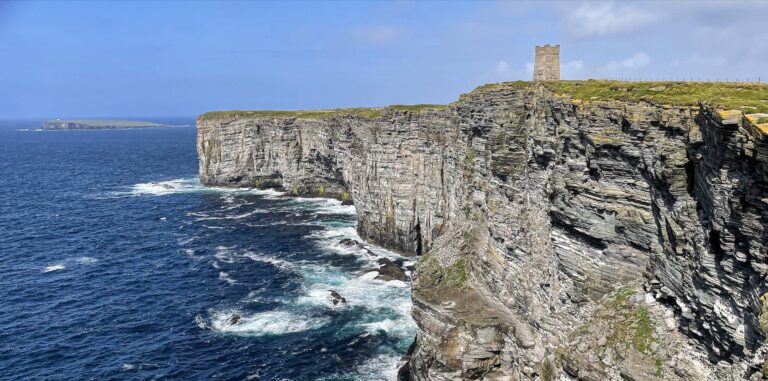
Against this Turner-esque seascape the rock columns stand in silhouette. These are the famous karst islands of Phang Nga Bay. I’ve sailed around rock stacks on islands off Scotland and off the south coast of Australia but in those locations they are barren, windswept and wave-crashed sentinels.
These stacks, in Phang Nga Bay, are largely protected from the worst of the storms and are full of life.
Living rock columns
One is really close now – about 2,000ft maybe or 600 metres away – and as we pass it we see birds hovering above its highest point, landing and then taking flight again. Nesting, we presume, or returning from flying missions with food for their young.
Vegetation covers the stack. Trees sprout from fissures in the grey rock, plants cling to ledges and what look like great clumps of moss coat other sections of the pillar.
Some of the karst islands here are little more than slim pillars, barely 30ft or 9 metres in diameter. As they descend towards the water they taper so the plinth on which they sit is narrower still. This makes them look so fragile that I think one nudge from a longtail boat whose skipper is not paying attention might be enough to topple them into the sea.
Others are much more solid. They have much broader bases measuring several hundred feet across and boast much more vegetation and even secret caves. At least one has a sea arch, which – although low – is just high enough for small boats to chug under it and emerge on the other side of the island.
Others still are proper islands, with landing spots and beaches.
World-famous locations
This remarkable place looks more like the result of Hollywood special effects but the karst islands of Phang Nga Bay are all natural and were formed over millennia by a series of geological processes. This entire region was once a shallow tropical ocean. As trillions of life forms died they compacted to create a limestone seabed hundreds or thousands of metres deep. Geological forces later raised this seabed above the waves leaving it exposed and subject to atmospheric weathering. Millennia later, the weaker limestone has been eroded leaving these stronger pillars and islands I am looking at right now. Presumably in millennia to come they too will erode and disappear but for now, they present one of most breathtaking landscapes in Asia.
Others have thought the same thing and several of the islands and stacks have become global superstars by featuring in films, including two James Bond classics: The Man with the Golden Gun and Tomorrow Never Dies. The bay was also used to represent Chewbacca’s home planet Kashyyyk in Star Wars Episode 3 – Revenge of the Sith.
You can take day trips on small boats to visit what has been dubbed James Bond Island and other spots here. But, right now I am happy to avoid the crowds and the influencers and instead cruise past these mighty geological wonders at a distance on my fish-scented substitute ferry under a blazing tropical sunset.
© copyright Matthew Brace