
Episode summary:
I am in one of my favourite parts of the world: the Windward Islands in the Caribbean. I’m in St Vincent and the Grenadines sharing my breakfast with my new friend, a very colourful Bananaquit bird. It’s one of the prettiest birds I have seen and I am delighted it has chosen me – well, chosen my plate of fruit. I may even postpone some snorkelling I had planned and hang out with the Bananaquit instead.
If you’re asking yourself ‘is it worth visiting St Vincent and the Grenadines’, ‘what birds are native to St Vincent and the Grenadines’ or ‘what are the most beautiful Caribbean islands’, this podcast episode might steer you in the right direction.
Listen to a podcast about sharing a tasty Caribbean breakfast with a beautiful local bird.
Transcript – S4 E1: Sharing breakfast in the Caribbean
This week we’re sharing breakfast in the Caribbean with a very colourful local.
I rarely eat breakfast. I know I should – ‘most important meal of the day’ and all that – but I always think there’s something more important to do, like going for a run or watching the mist lift from a mountainside.
So when I do actually take the time and sit down to a hearty morning feast I am adamant it does not get interrupted.
This morning I made a great effort to wake early. I watched the sun come up. I took a quick dip in the sea and was ready for breakfast by 8am. I must admit getting up to greet the day here is a complete joy, because I am in one of my favourite parts of the world: the Windward Islands in the Caribbean. To be more precise, I’m in the north-to-south chain of islands known as St Vincent and the Grenadines. Sounds more like a cocktail!
Meeting the locals
I know the Windward Islands quite well but I haven’t been back here for some years. Not much seems to have changed. The weather’s still idyllic, the people are still lovely and the seafood is still spectacular.
On my table is a plate of scrambled eggs and fried plantain, a bowl of rice and beans, a large fruit juice and an even larger pot of tea. There is also a plate of sliced mango and papaya. It all looks very tropical, very Caribbean… and very tasty. And not just to me. Within a few seconds of removing the fly-screen cover from the plate of fruit I am joined by a local.
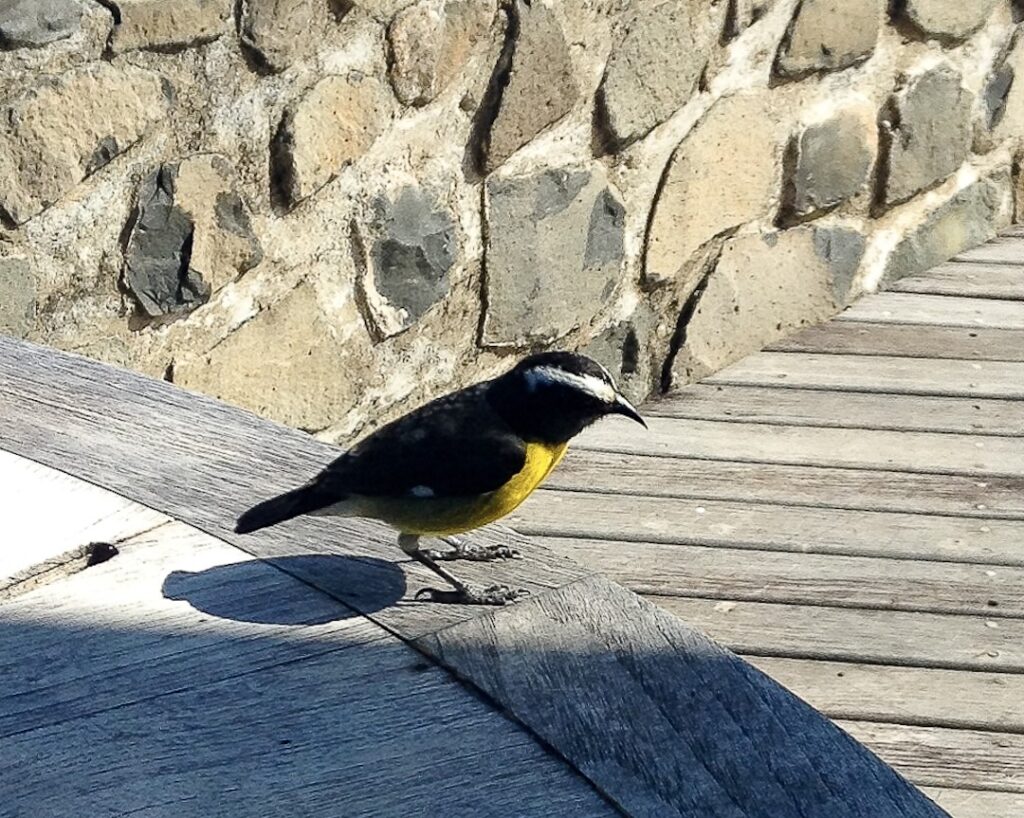
The first thing I know about the local’s arrival is a vibration and a very slight draught. Then – plonk – the local lands on the edge of the fruit plate and perches there, looking at me. It’s one of the prettiest birds I have seen. It has a bright, lemon-yellow breast and underside, and twin white streaks, one on either side of it head. Elsewhere it is black and grey, muted tones that allow its tropical colours to really stand out.
It’s a bananaquit, a bird endemic to the warmer parts of the Americas. I am told there are three distinct groups, including one that favours Jamaica and Hispaniola, another that hangs out in the Bahamas and one – called the bartholemica group, in case you were wondering – that inhabits Central and South America and the Lesser Antilles, of which the Windward Islands are a part. There’s also a sub species right here on the Grenadines but I don’t have the taxonomy knowledge to know which one this belongs to.
Breakfast for the birds
Whatever its lineage, there’s no doubt what the bananaquit likes to eat. The papaya is taking a beating. The bird is chiselling away at one slice, getting it all over its beak. It’s found its breakfast gold.
It flits away for a minute and then returns, beak clean again and ready to chisel some more. This time it lands less than a foot from my left hand and cocks its head to inspect what’s on my fork. “Hmm, plantain. Looks like banana but is a fake banana… not sweet,” the bananaquit thinks. At least, I think that’s what it thinks.
The plantain is rejected and with one hop the bird is back on the fruit plate, devouring the papaya once more and flitting away again with a full beak. Maybe it is feeding young… or a partner somewhere.
Now it’s back again. It has an approach trajectory which does not change. First it flits onto my hammock, then my t-shirt drying in the sun, then the far edge of the table, and then – its target – the breakfast set up.
I am struck by how well-mannered it is. It waits patiently. It stays on the edge of the plate, rather than trampling over the slices and making a mess. It nods its head to me every now and then… maybe its way of saying “thanks for letting me share your papaya”.
A suitably colourful bird for the tropics
As it is so calm and close I get a chance to focus on its colours. All I have to do is keep still and not make any sudden movements. This forces me to slow down, to eat slowly, to move slowly… to think slowly. It’s encouraging me to be mindful.
The bananaquit really is quite beautiful. It is, I suppose, maybe four inches or 10cm from its beak to the tip of its tail and is a deft flyer, occasionally launching into the breeze that is blowing around the ocean side of my villa and hovering briefly before navigating neatly back to the table.
It has a slender beak, ideal for sucking nectar from flowers or, in this bird’s case, extracting papaya from a fruit plate. No surprise it has gained the nickname, sugar bird.
Some sub species have a white throat before the yellow kicks in on the chest but this one’s throat is a charcoal grey. I do wish I knew which sub species it was from. Where’s David Attenborough when you need him?!
I’m on ‘bananaquit time’ now
The bird hops between sunlight and shade and as it does so, the yellow changes. In sunlight it is lemony but in shade it is more of a – as its name suggests – rich banana hue.
Time ticks away. The sun rises higher. The Caribbean day warms. I am supposed to go snorkelling soon but I am on island time now – or bananaquit time – so I will stay here and continue to share my breakfast with my new friend, no matter how long it takes.
© copyright Matthew Brace