
Episode summary:
The Orkney Islands off the north coast of Scotland make up one of the world’s most important seabird sanctuaries, with thousands of birds flocking here every spring to breed and to nurture their young. I visited in July when the airspace around the cliffs was as busy as it gets. Kittiwakes, razorbills, fulmars, shags, terns and birds I had travelled a long way to see: puffins!!
If you’re wondering ‘what is special about the Orkney Islands’, ‘what seabirds will I see in Orkney’ or ‘what are puffins called in Orkney’, this podcast episode might shed some light on the situation.
Listen to a podcast about watching Orkney’s incredible summer seabird spectacular.
Transcript – S4 E2: Seabird spectacular on Orkney
This week we’re experiencing the beauty of the annual seabird breeding season on Scotland’s Orkney Islands.
I’m lying on a grassy cliff looking at a very rare and very beautiful flower. It has five mauve, heart-shaped petals surrounding a yellow eye and can’t be more than 10mm in diameter. The flower seems far too delicate to be able to stand the gales that batter this coastline, which send knock-down winds, giant waves and curtains of salt spray to rake the cliffs. Even on a mild summer evening such as this the breeze is fresh. Yet this little flower hangs on bravely as it nods and bends.
My guide Megan lies down next to me. “Primula scotica,” she says, “the Scottish primrose.”
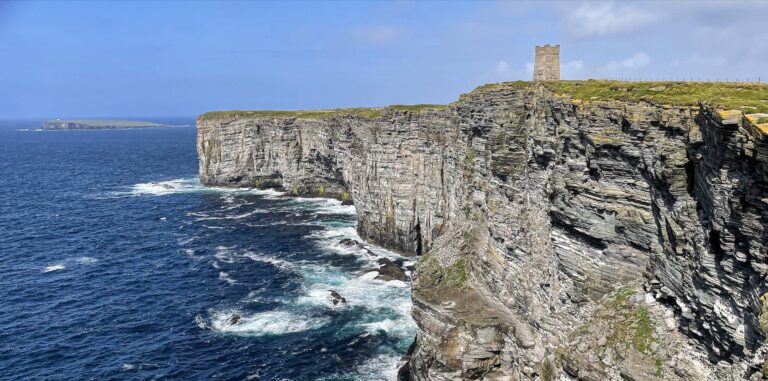
Megan and I are at Yesnaby cliffs on Orkney, a scatter of islands a few miles off the north coast of Scotland. The cliffs face west to the wild North Atlantic Ocean. This is one of only a few spots in Orkney in which this primrose is found, along with a few remote parts of the Scottish mainland. If it wasn’t for Megan I would have probably walked right by it, or – perish the thought – stepped on it.
Orkney wildlife masterclass
Megan runs a small company called Wild Orkney Walks. She has won awards for her interpretive nature strolls which doesn’t surprise me one bit because they are not only informative but enchanting too. I must have taken scores of guided nature walks over the years but I can’t remember a guide who was so perfectly attuned to the environment. Megan doesn’t just know a lot about Orkney, she feels this place too. She is instinctively connected with the land.
She hears something behind her, over the cliff, and jumps up, grabbing her binoculars.
“OK, we’ve got some tammy norries,” she tells me. Tammy norrie is the local term for a puffin, a bird I have travelled a long way to see, so, I jump up too and train my binoculars on the cliff.
“Oh, that’s great!” Megan says. “One of them has some sand eels in its beak.”
I see it too, now.
This is, indeed, great. Sand eels are a staple of the puffin’s diet – and that of many seabirds here – but the coastlines of the UK have suffered a huge decline in sand eels in recent years, mainly due to over-fishing, which has negatively impacted seabird populations. But in 2024, after years of pressure from organisations such as the Royal Society for the Protection of Birds, the UK banned industrial sand eel fishing in all Scottish waters plus the North Sea coast of England.
Could this puffin with its beak full of silvery sand eels be early evidence of a recovery? Megan and I do hope so.
I am still watching the puffin when Megan calls out: “There’s a bonxie!”
A what?
“Sorry, it’s another local name,” she says. “It’s a great skua. Oh yes, and there are some mallimacs over there on the far cliff.”
Who? Malli-who? Mallimacs are fulmars – gull lookalikes.
Coordinated chaos on the cliffs
Orkney is one of the world’s most important seabird sanctuaries, with thousands of birds flocking here every spring to breed and to nurture their young, and there’s a long list of Orkney names for them. These descend from the Old Norse language, a throwback to Orkney’s Viking past 1,000 years ago. An oystercatcher, for example, is a ‘skeldro’, a guillemot an ‘aak’ and an Arctic Tern is a ‘pickieterno’.
The airspace around the cliffs is as busy as it gets. Razorbills and kittiwakes hurl themselves off narrow ledges and shoot down to skim along the tops of the waves. Black shags sit on rocks and dry their wings in the late sun. Great skuas – sorry, bonxies – the great thieves of the cliffs, patrol menacingly, looking for food to steal. Further out to sea great white gannets scan the surface and then – kamikaze-like – plummet down and smack into the waves to catch fish.
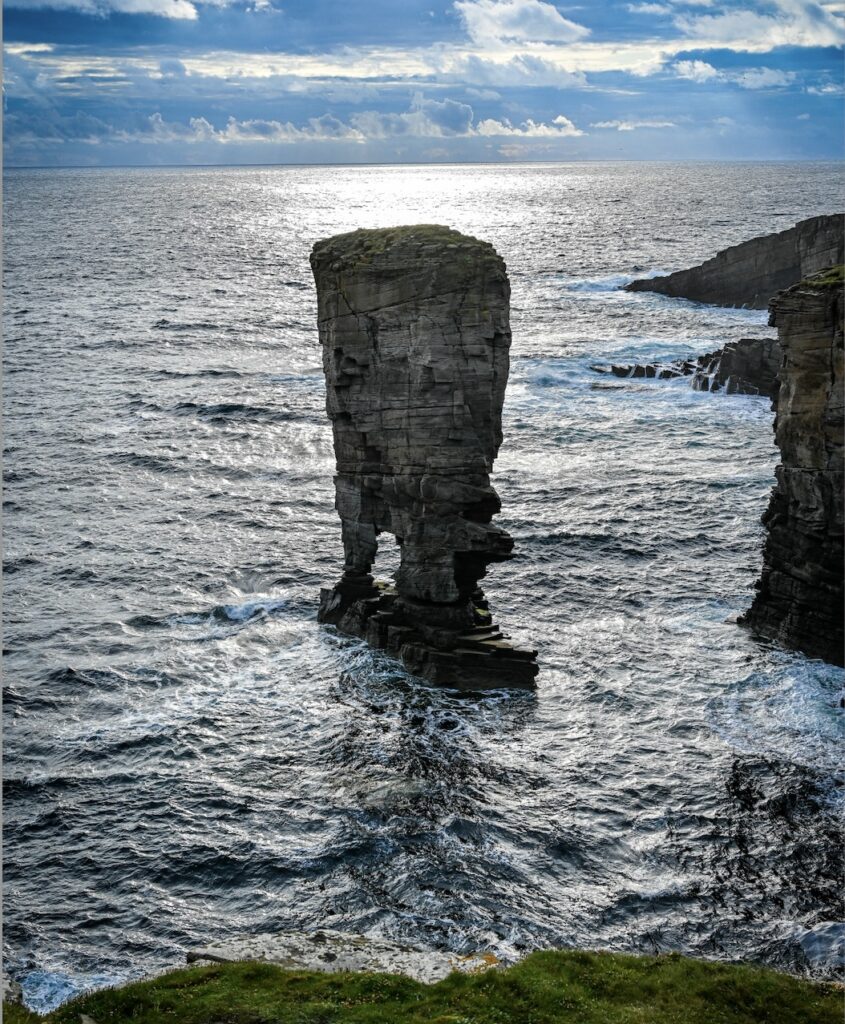
We are looking at a stunning rock stack just offshore – a lone pillar separated from the cliff but still standing, defying the Atlantic winds and waves.
Birds are flying all around it, some landing on its far west-facing flank. Others come much closer to us. Puffins fly past sideways on the breeze, showing off their aerobatic skills. One or two look wildly out of control and make clumsy landings near their burrows. Others glide in from the open ocean using the up-draft near the cliff to shoot up and up… until they plop down on rocky ledges.
An evening to remember
The puffin with the sand eels waddles into its sandy clifftop burrow to deliver the catch of the day, then re-emerges and launches itself off the rocks again. It’s 8pm and the sun is still blazing away over the ocean behind a thin layer of cloud. It’ll be light until about 11pm and the birds will keep doing fishing runs as long as they can. Every minute of these brief summer months is critical for Orkney’s seabirds.
The sun peaks out below a cloud and the entire scene is bathed in golden light. Suddenly we can see the full extent of the airborne colony… thousands of black and white flecks illuminated by the sun against the Navy blue of the sea. And we see that almost every rock ledge and grassy outcrop is claimed. Adults groom their young, couples snuggle up together and there is constant chatter.
In this magical moment on Orkney, immersed in nature, I forget the stresses and fears of the world and everything seems safe and calm.