
Episode summary:
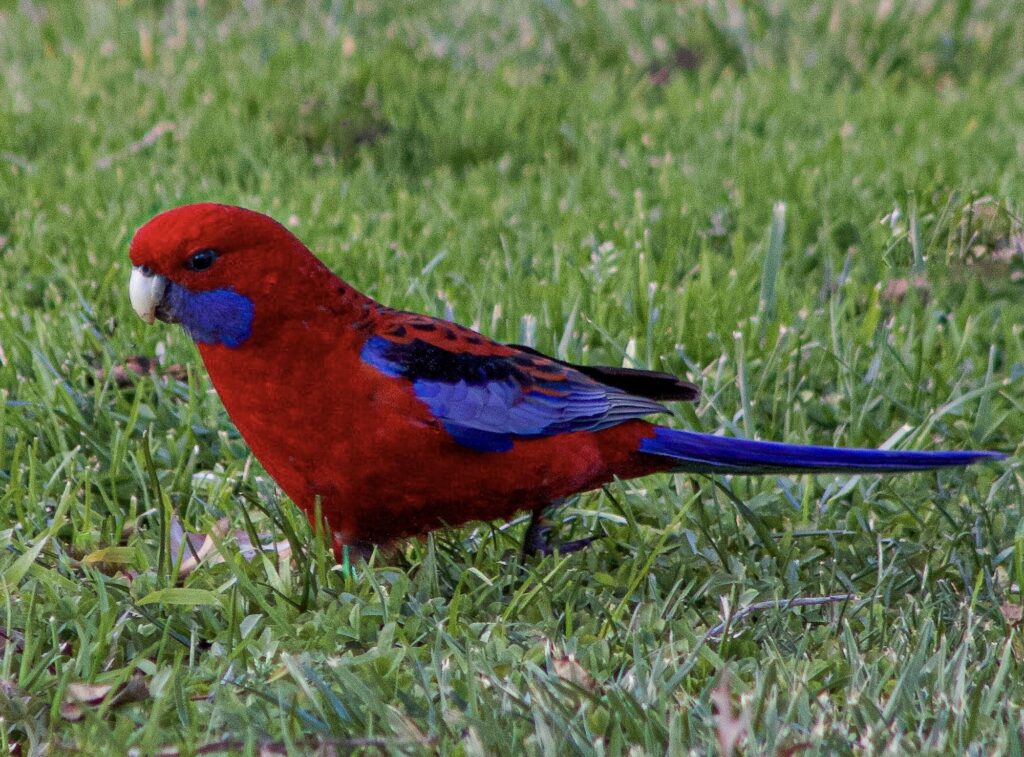
I spent a searingly hot summer afternoon in Australia’s capital city, Canberra, watching resplendent Crimson Rosellas. These are possibly the most beautiful and flamboyant birds in Australia and the great thing is they are relatively easy to see. If you are wondering ‘what does a Crimson Rosella look like’ or ‘do Crimson Rosellas mate for life’, this podcast might have some answers for you.
Listen to a podcast about the resplendent Crimson Rosella.
Transcript – S2 E3: Crimson delight in Australia
This week we’re having a close encounter of the crimson kind.
The Crimson Rosella is quite possibly the most resplendent bird in the world. It certainly is in its native Australia. Of course that’s just my opinion and I’m sure there are fellow bird fanatics out there who might disagree, instead favouring such wonders as the Gouldian Finch or the Rainbow Lorikeet or the flamboyantly named Forty Spotted Pardalote.
They’re all stunning Australian birds but for me nothing can top the Crimson Rosella. I’m looking at one right now. It’s about 10 feet away on the branch of a photinia tree, sheltering in the shade. It’s blisteringly hot out here on this scorching summer January afternoon in Australia’s capital, Canberra. There are no birds on the wing. They’re all under cover, waiting for the cooler breezes of evening so they can begin feeding again. The rosella is in a great spot for me to get the full visual experience because its colours look richer and more vibrant in the shade. They can be washed out a bit when seen in full sun. For the bird in front of me, this is a chance to get a little personal grooming done, running its beak tip through its feathers. It works diligently, not leaving anything unspruced.
A riot of colour
The rosella’s main colours are red and blue, but within each is a multitude of shades and sub-colours. The main red, the crimson, dominates on its breast, head, lower belly and the underside of the beginning of its tail. Its back is red too but peppered with black spots, crescents and semi-circles. Under its beak it has a bright blue throat. However, the throat of the one I’m observing right now looks more violet than blue. That shade matches its lesser, covert feathers at the bend of its wing. But those same feathers also include a set that is a deeper ultramarine blue and another which is a powdery sky blue. Its tail is a collection of perfectly layered and gradated feathers in cobalt, azure and lapis lazuli. It’s a riot of colour, just magnificent.
Years ago I was left open mouthed at the sheer beauty of a pair of scarlet macaws I saw in a forest in Nicaragua, whose plumage was a veritable rainbow of colour. I’d never seen anything like it. Years later, I met the Crimson Rosella and fell in love all over again. It’s as if the macaws are painted with pastels – stunning, sure, but softer colours – while the rosellas are adorned with vivid acrylics or Indian inks. There’s an intensity to their colours that few other birds possess. And here’s another bonus: you’re almost certain to see this bird in pairs as, like their Latin American cousins, they mate for life. So double the colour, double the fun.
In fact, when I see a Crimson Rosella on its own, I wonder if it’s had a tiff with its partner and is sulking until whoever started the disagreement brings a peace offering. I imagine a tasty caterpillar would do the trick. Just as I’m thinking this, here comes its mate, landing on a nearby branch with a half-twitter, half-squawk as if to say: “So this is where you are; been looking for you all over the place. Crikey, it’s hot.”
Airborne artist’s palette
The mate sidesteps down the branch, hops onto the one its partner is occupying and they exchange low notes with each other. It’s like they’re whispering. Canoodling. A few seconds later, they take flight together. Suddenly all those layers of feathers, all those colours, make sense. Now I can see them all working in harmony to let them glide over the small grassy clearing in front of me and into the trees beyond. All the shades and sub-colours are on display in an airborne artist’s palette.
As I watch them fly, I’m reminded of some wise words from a Native American First Nations leader I met in Utah years ago, when I was a fresh-faced foreign correspondent. I’m paraphrasing here but roughly he told me the best teacher you can ever have is nature. He said I would learn more from the trees, the wind, the birds and the wild oceans than I would from any human. “So,” he said, “be amongst it as much as you can; respect it; hear its rhythm; be part of it.” How right he was.
© copyright Matthew Brace