
Episode summary:
I travelled for several days to reach the remote Pacific island of Yap to meet the locals and learn the story behind their giant stone coins. This must be the most beautiful Pacific island I’ve ever seen. I felt like I had travelled back a hundred years or more to a simpler, slower time when nature dictated our pace. If you’re wondering ‘where is Yap island’, ‘what is Yap island famous for’, or ‘what is the giant stone money on Yap’, this podcast might have some answers.
Listen to a podcast about very slow travel on the blissfully relaxed island of Yap in the Pacific.
Transcript – S2 E8: Very slow travel in the Pacific
This week we’re doing a whole heap of nothing on the Caroline Islands in the Western Pacific.
It’s mid-afternoon on the sleepy island of Yap and I have nothing to do. I’m sitting on a log in the shade at the back of an idyllic beach and chewing betel nut with a local village elder. We’re not speaking. Not because we’ve fallen out but because, well, what is there to say really? Perfect weather, perfect beach, absolutely nothing on the agenda for the next few hours and to top it all we’re getting mildly stoned on the narcotics in the betel nut. There’s also the language barrier but even if we were fluent in each other’s tongues we’d still probably sit in silence and bask in the tropical splendour of the afternoon.
I’m also still glowing from the thrill of snorkelling with manta rays which I did earlier today in the Miil Channel with my American buddy Bill who’s lived here for decades and owns and runs the rather wonderful Manta Ray Bay Resort. Also, my stomach is satisfyingly full from a beach lunch of fried fish and red hot sambal.
The village elder’s eyelids are drooping and I feel it’s almost nap time.
Giant stone money coins
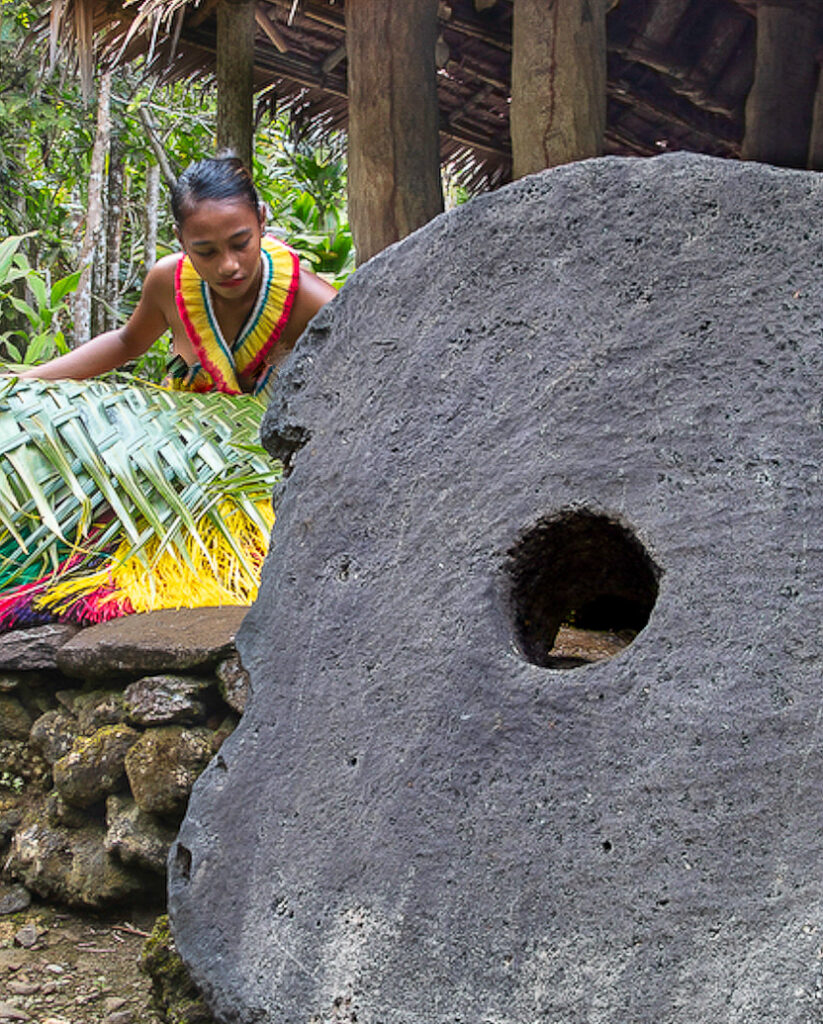
On the other side of a red-flowered hibiscus bush giant stone discs are propped against the edge of a community meeting house. Some are at least four feet (or 1.2 metres) in diameter and each has a hole carved through its middle. These are the island’s famous rai stones. Until relatively recently when the US dollar took over, these giant and rather impractical coins made up the island’s currency. They would be used for all sorts of debts. Some of them have clearly been here for years – decades really – as they are covered with a green layer of moss or lichen. When he was showing off the coin collection before lunch the village elder told me in Pidgin English that not all of these discs actually belong to this village. Some were exchanged with other villages or individuals decades back, usually when there was a marriage. But they were too heavy and cumbersome to move so they are banked here, out on loan if you like, a bit like a museum displaying an artwork from a private collection. He can’t remember the last time one of them was moved but it takes at least half a dozen people to shift just one of them. “Am I allowed to touch them?” I asked him. “Sure, go ahead, just don’t scratch any of them,” he said.
It’s not just the size that determines a disc’s worth; it’s also its history. Most of the early ones came from the island of Palau, which although technically a neighbour is still 280 miles (or 450 kilometres) away over a sometimes choppy ocean. The fact that they brought these incredibly heavy stones all that way on a dugout canoe is remarkable, so I totally get why they are the most valuable ones. Apparently there were other forms of currency here too before the dollar: cloth, shells and spice balls apparently but nothing is as impressive as these giant stone coins.
A stroll through Yap
The village elder is sleeping now. He slid gracefully off his log a few minutes ago and sat down on the sand with a bit of a thump which woke him temporarily but he’s snoring away again now. Quietly I take my leave. I find the frangipani branch I carried when I entered this village – an essential item for a stranger on Yap to wield to show you come in peace – and follow a grassy path through the forest to another beach I’ve been told about.
This must be the most beautiful Pacific island I’ve ever seen. I feel like I’ve travelled back a hundred years or more to a simpler, slower time when nature dictated our pace, not spreadsheets, airline timetables and mobile phone reminders. At any moment I expect to come across a clearing in which I’m sure I’ll find Gauguin painting a couple of bare-breasted island women with flowers in their hair. Instead my only companions are brightly coloured birds hopping between the hibiscus, busily doing whatever brightly coloured tropical birds do on hot afternoons. The foliage retreats and I find myself in another small village with more stone money. The discs are smaller here but no less thrilling.
A young girl suddenly appears wearing a multi-coloured and multi-fronded grass skirt. She twirls excitedly. She can’t be more than six or seven and as she grins at me I see she has a front tooth missing. I wonder if she tucked it under her pillow and the Yap Tooth Fairy brought her one of these giant stone coins. Now that would be a neat trick!
I hold up my frangipani branch to prove my peaceful intentions and she smiles again and skips along a path laid with flat stones, tapping the stone coins as she goes. She seems to be full of joy, finding pleasure and wonder in everything she sees and touches. What an idyllic place to grow up in, to have both freedom and safety at the same time. At the end of the path is the beach, a short boomerang of white sand. The girl is at the far end of it. She does a couple of cartwheels and disappears into the wood at the end. I flop down on the sand, happy to be in paradise with still absolutely nothing to do.
© copyright Matthew Brace