
Episode summary:
I travelled to the haunting Skeleton Coast of Namibia in southwestern Africa to experience one of the world’s most remote places. This is a lonely land of sand, shipwrecks, skulking jackals and a very clever ‘fog beetle’.
If you’re asking yourself ‘why do they call it Skeleton Coast’, ‘why are there so many shipwrecks on the Skeleton Coast’, or ‘is the Skeleton Coast worth visiting’, this podcast might be able to point you in the right direction.
Listen to a podcast about life on the haunting Skeleton Coast of Namibia.
Transcript – S2 E8: Alone on the ghostly Skeleton Coast
This week we’re meeting the resilient and slightly comical wildlife on one of the loneliest and most remote beaches on Earth.
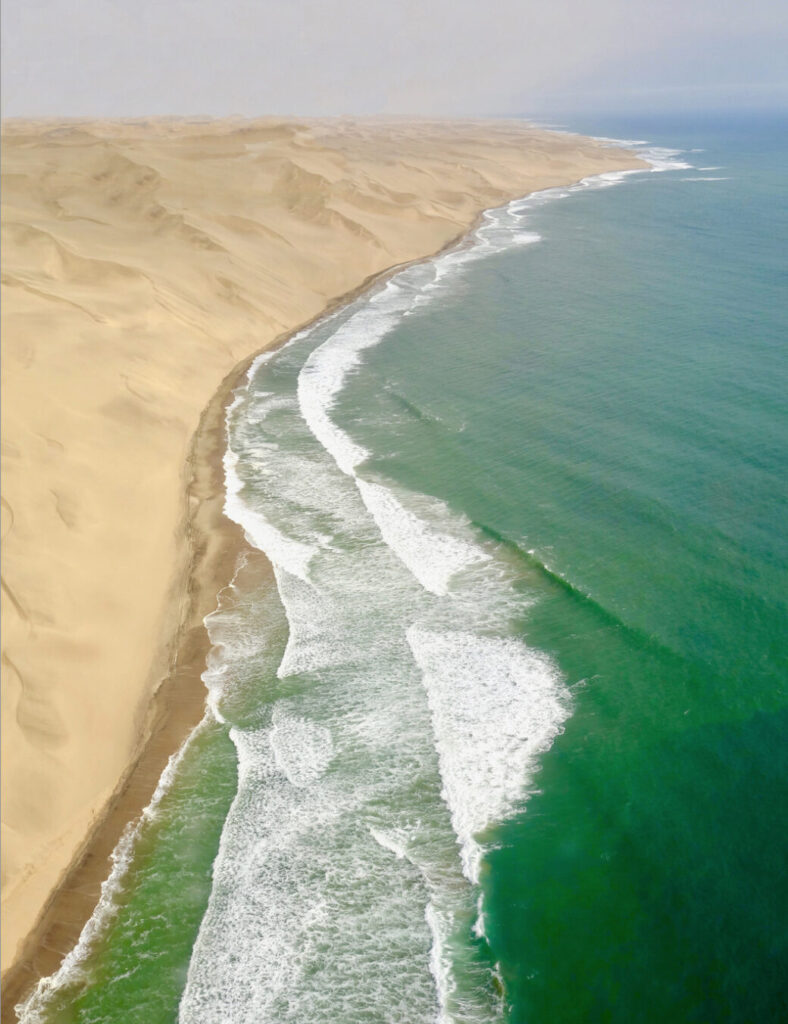
Looking north I can see for what I estimate to be more than 10km. Beyond that, the salt spray from the pounding waves mists the scene. Turning around I feel I can see the same distance southwards too and in each direction the view is the same: beige dunes reaching down to a long, deserted beach. But the word ‘long’ is an understatement, for these dunes and this empty shoreline stretch for something close to 1,000km. Even though I love my solitude, it is just slightly daunting that there’s nobody else here.
Raw beauty and resilience
This is the quite spectacular Skeleton Coast National Park on the coast of Namibia in southern Africa. It’s not like anywhere I’ve ever been. I’ve been to remote places, but none so distant from civilisation. I’ve been to deserted places, but none so devoid of humans. It’s in places such as this that the tiniest mishap can become a catastrophe quite quickly if you’ve not taken the right precautions. But I’m trying not to think of how much drinking water I packed, whether one spare tyre is going to get me safely through the wilderness, and if I’m experienced enough to get my four-wheel drive out of a soft sand dune if I get stuck. Instead, I’m focusing on the raw beauty of this place and the amazing and utterly resilient birds and animals that call it home.
My mind initially remembers a small black beetle I saw yesterday when I was traversing the dunes on one of the few driveable tracks. It was a toktokkie, or fog-basking beetle, and it’s native to the Namib desert, which has been my home for the past week. This incredible bug has evolved to survive the harsh climate here, one of the most arid on earth. When the fog rolls in in the evening, it clambers up a sand dune – a Herculean effort for something that’s only 65mm long – lowers its head and raises its backside in the air. This beetle yoga pose means water droplets from the fog run down its torso – if beetles have torsos, I must check that – and into its mouth. It’s the only beetle in the world known to do this and I commend it for its inventiveness and for its comedy value.
The toktokkie’s life-sustaining fog happens courtesy of the cold Benguela current running north along the coast just offshore, driven by trade winds from the south. Some evenings the fog barrels in like a freight train, others it creeps stealthily, almost imperceptibly, until it’s licking at your heels. Combine that enveloping curtain of gloom with the isolation and then throw in the haunting wail of a skulking jackal and you’ve got one seriously sleepless night ahead, even if you are locked into your vehicle.
It’s called the Skeleton Coast for a reason
The jackals survive here by hunting fur seals, the pups mainly. Until recently there were lions here too. It sounds impossible, but a few ‘coastal lions’, as they became known, were seen regularly, also preying on seals. But they haven’t been seen for some years now. Also resident here are particularly sturdy types of desert elephant and giraffe who have also adapted to the challenging conditions. With so many things to attack me out here, not bringing a second spare tyre was starting to niggle at me as evening fell and I peered out into the grey mist.
At least I had shelter, unlike the thousands of souls shipwrecked here over the centuries. If they did not drown in the almost always tempestuous surf and managed to avoid being chomped by the great white sharks patrolling the shallows, they landed on a desert beach. They then had to fend off jackals, lions, elephants and snakes and trek inland through utterly arid desert for scores of miles with nothing to eat or drink. This place is not called the Skeleton Coast for nothing. Actually, it probably got its nickname from the numerous whale carcasses that rotted down here when the area was a whaling centre and from the scores of skeletal rusting hulls of boats lost in the fog, smashed to pieces on the rocks and forever beached on the sand.
The waves seem to be louder suddenly and more violent so I move my car up the beach a bit further above the high tide mark. As I try to calm my fears, pull a blanket over me and ready myself for what may be some broken sleep, I hear the jackal once more. It is closer now.
© copyright Matthew Brace