
Episode summary:
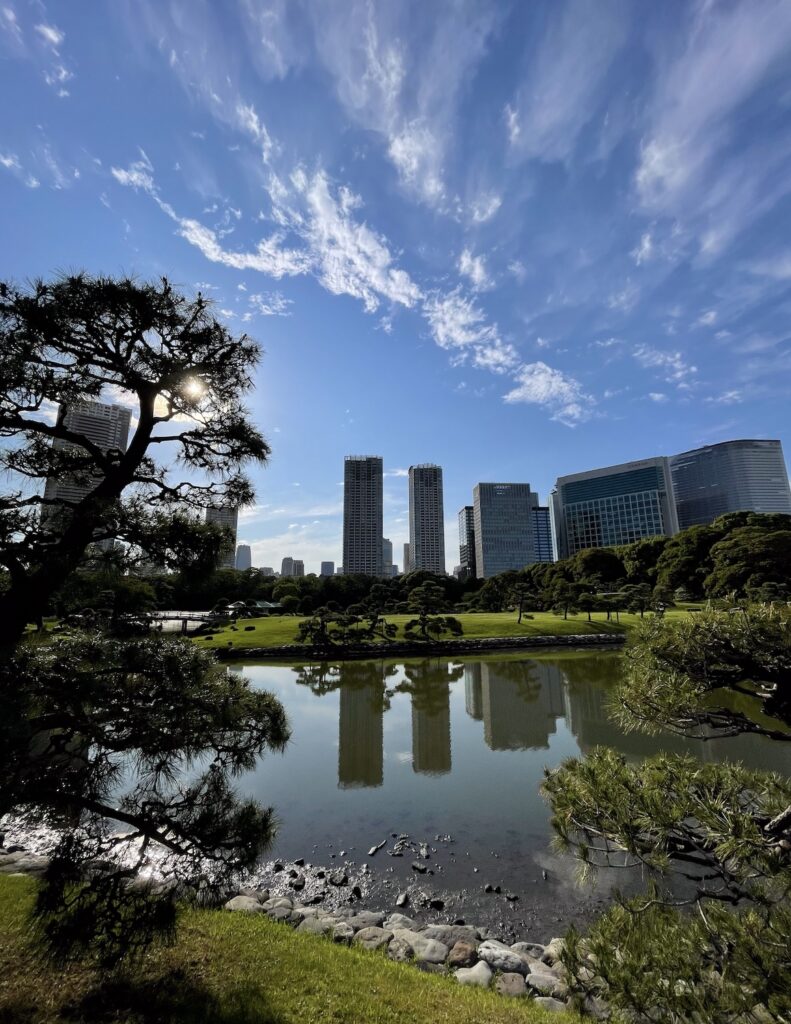
I found peace and calm in a natural oasis in the middle of Tokyo and it was totally unexpected. I went for a walk looking for a spot to sit on the waterfront of Tokyo Bay and watch the seabirds. Instead, I found the Hama-rikyu Gardens, which date back to the 1600s. The gardens are full of graceful cedars and include groves of plum and cherry trees, a bank of peonies and a wisteria trellis. There are also small teahouses which appear to float magically on the lake.
If you are wondering ‘are the Hama-rikyu gardens worth visiting’, ‘which is the best garden to visit in Tokyo’, or ‘how to find peace in a Japanese garden’, this podcast might be able to help.
Listen to a podcast about finding tranquillity in the centre of Tokyo.
Transcript – S3 E1: Tokyo tranquillity in an urban park
This week we’re indulging in nature meditation in a tranquil city centre garden in Tokyo.
I’m near Shimbashi train station, a little south of the Imperial Palace and the dead centre of Japan’s capital city. In the open-air shopping mall several hundred young hopefuls are waiting in line to get on stage for what looks like a mass audition for a new boy band.
There must be a collective noun for hundreds of boys all wearing their cargo pants at half-mast and flashing their undies but I don’t know what it is. A ‘hip’ maybe? A ‘slouch’ perhaps? When they hit the stage in groups of five, music blasts from speakers and ricochets around the mall. It seems an odd way to start a day of meditative rejuvenation but this is Tokyo where noise and clatter often sit next to total tranquillity.
A short walk from the pelvic thrusts and the 148 beats per minute of Japan’s next boy band, I find a broad expanse of trees and green space. I was looking for waterfront, so this is a bit of a surprise, but a good surprise. I buy a 300 yen ticket and I’m sure the ticket seller has undercharged me. That’s less than two US dollars, a pound 40 in British Sterling and a little over two dollars fifty Australian. If you’re over 65 you pay half these amounts. This ticket, arguably the best value for money anywhere in Tokyo, grants me access to one of the most beautiful parks I have ever visited, anywhere: the Hama-rikyu Gardens.
Under ancient trees
I crunch down a gravel path under cedars and ornate pines and the slightly humid summer air is infused with their morning scent. One of these beautiful trees is reputed to be at least 300 years old, planted to commemorate improvements to the garden made by the sixth Shogun Iyanobu. It’s more a sprawling bush than a tree but unquestionably magnificent. I park myself on a bench nearby and watch the pines wafting gently in the breeze and spot two herons and a lone egret waiting patiently to grab a fish in the shallows of the lake.
At strategic points along the lake shore are volcanic boulders skirted by perfect emerald lawns, smoother than a golf course green. I get the impression that each one has been carefully placed by a zen master. On one boulder a brilliant blue and black butterfly lands, taking a breather from its morning tour of the gardens’ cosmos flowers that are in bloom here right now. There’s also a satisfying buzz from the myriad bees that are diligently drifting from flower to flower. In spring – which I’ve missed – the groves of plum and cherry trees are a mass of blossoms reflected dramatically in the black still waters. There’s a bank of peonies too and a wisteria trellis to add to the floral canvas.
Happy birthday Hama-rikyu
These gardens are officially 80 years old this year, having been inaugurated as a public park on April 1st 1946, but their history goes back much further, to Japan’s Edo period. In the 1600s this was a private garden for the Tokugawa Shogun and went through numerous renovations over the centuries, including the addition of a tidal pond, the only one in Tokyo that remains from the Edo period. A lock gate is opened and closed to let water flow in from and out to Tokyo Bay, and keep the lake fresh and stocked with fish for the herons and egrets.
As I walk slowly through these gardens I realise there are, in fact, several lakes here. A couple of them feed into each other through narrow channels under arched wooden bridges. Various designers over the centuries added small wooden teahouses, or ochya, and located them carefully so they appear to float magically on the water.
Mindfulness among the masses
Near one of them is a patch of green which my map temptingly labels “Yagai Taku Open Space – Picnic Sheets OK”. I don’t have a picnic sheet to hand but I lie down on the grass anyway, listen to the bees and realise I can’t hear the city at all. Just over there – literally just beyond those pines – is one of the largest metropolises in the world; more than 33 million people in the city alone and this park is in the thick of it all. But all I can hear is the hypnotic buzz of summer bees and the occasional plop of a fish surfacing on a lake. I can’t hear traffic or construction or even wannabe boy-band auditioners. I wasn’t looking for this park; I didn’t even know it existed an hour ago. Nature is always a wonderful thing to be immersed in but it’s somehow even more glorious when you stumble upon it by accident.
© copyright Matthew Brace