
Episode summary:
I am in one of my favourite green spaces in Asia: Singapore’s magnificent Gardens By The Bay. There’s something wonderfully peaceful about being here and doing nothing but staring at nature. In Singapore, this is the best way to start the morning and give you the mental strength to tackle whatever the day may throw at you later.
If you are keen to find out ‘what is special about Gardens By The Bay Singapore’, ‘what are three of the attractions at Gardens by the Bay in Singapore’ or ‘how are Gardens By The Bay sustainable’, this podcast might be able to help with some answers.
Listen to a podcast about the early morning joys of Singapore’s glorious Gardens By The Bay.
Transcript – S3 E5: Dawn in an Asian tropical garden
This week we’re watching a fabulous tropical garden come alive in the dawn light.
It’s just before sunrise on the edge of Singapore’s Marina Bay. I am looking east to the Singapore Strait where hundreds of container ships and tankers are moored, waiting to enter the city huge port. In the distance the first rays of sunlight reflect off the big jets coming into land at Changi Airport.
Over my shoulder stands the futuristic Marina Bay Sands hotel with its skinny, sky-high platform perched on three glass towers like a giant metallic eclair delicately balanced on a conceptual cake stand.
But today I only have eyes for natural things, so I make my way into one of my favourite green spaces in Asia: the magnificent Gardens By The Bay.
I enter just beyond the smaller of the two climate-controlled, glass-domed conservatories – the one that harbours a cloud forest. The path takes me along the eastern edge of Kingfisher Lake, one of two in the gardens complex, the other being Dragonfly Lake.
Smart eco-design
The two lakes work in harmony as a natural filtration system for rainwater while also providing habitats for fish, birds, dragonflies and aquatic plants. Treated water from the lakes is used in the irrigation system for the gardens in a neat little eco-loop.
The path winds through the Kingfisher Wetlands and is fringed with myriad palm species, tropical hardwoods and stands of brilliant bird-of-paradise plants. Through the foliage I spot the metal statues of two giant kingfishers, one sitting on a rock and one in flight, just after it launched itself to dive for a fish.
The wetlands contain more than 200 mangrove trees and related plants, including critically endangered ones such as the Firefly Mangrove. The wetlands are another example of the gardens’ smart eco-design as mangroves are known to have the power to sequester more carbon than rainforests.
It is still mild out here – just after dawn – but I know in an hour or two the heat and humidity will return. I have walked through these gardens in the middle of the day before and it’s much harder work… dawn is by far the best time to explore them.
Bird sanctuary
I catch what I think are the whistles of a black-naped Oriole and the subtle under-the-breath burbling of a white-breasted waterhen. I can see neither bird. There’s another call – a louder cry – and I am fairly sure that is a kingfisher… a real one this time rather than a statue. Then, in a flash of yellow across the surface of the lake, the black-naped Oriole streaks. I can’t help thinking it should be renamed the Yellow-breasted Oriole because when it dashes past you in flight, that is the only colour you see.
The path winds away from the lake and brings me to the shores of the water lily pond. I spend a few minutes on its grassy banks, sitting on a boulder and gazing out over the still water and emerald lily pads, while getting drunk on the heady scent from the fragrant frangipani trees. There’s something wonderfully peaceful about being here and doing nothing but staring at nature. In Singapore, this is the best way to start the morning and give you the mental strength to tackle whatever the day may throw at you later.
If you sit here long enough by this lily pond, one or more yellow-and-white trumpet flowers might fall from the frangipani onto your shoulders. They are just slightly cool to the touch and have five silky petals, white on the outside edges and egg-yolk-yellow in the middle. I carry one with me as I continue my walk, breathing in its honeyed scent.
Slow travel at its best
I like to walk almost in slow motion through these gardens, partly to stay cool but also because I don’t want to do the gardens all in one go. I like exploring this place section by section, keeping parts of it for future visits… something to look forward to. This slow-travel approach also means I can focus on particular plants or bodies of water, wait for shy birds to emerge… and practice mindfulness. I keep telling myself, there’s absolutely no rush.
Today’s exploration ends at the bold and globally recognisable centrepiece of the gardens, known as the Supertree Grove.
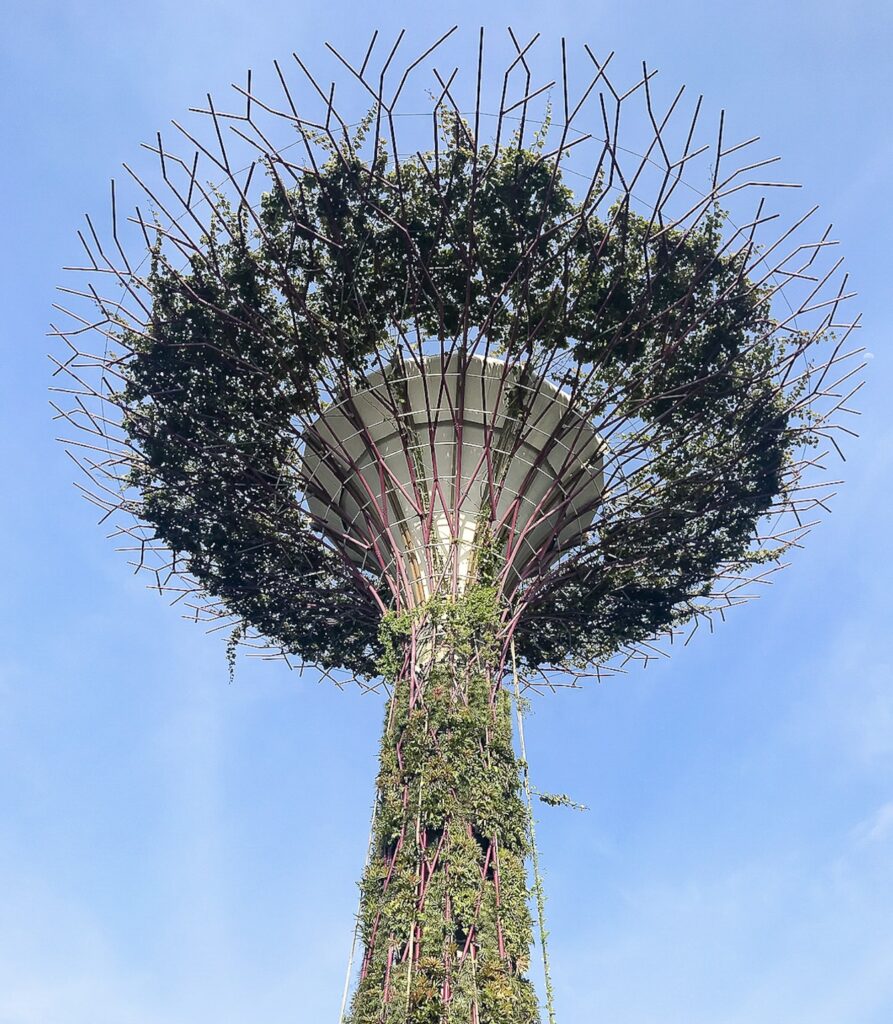
The towering Supertrees are artificial structures which rise from the ground like giant candlesticks, 22 metres or 72 feet into the air and then spread out horizontally at the top into round canopies. The supertrees house vertical gardens and as time has gone on, they have become lusher and lusher as more and more plants have ‘moved in’ and flourished in the moist, tropical climate.
They are just the kind of structures that sci-fi writers of the sixties and seventies might have dreamt up as futuristic food sources on distant planets. I remember reading those books when I was a boy and finding hope in the idea that we humans – for all the damage we do to this lovely planet – can also come up with solutions to conserve nature.
As I look up at the Supertrees, I realise I am witnessing one such potential solution and hope it acts as a beacon to the world to turn towards nature rather than against it.
© copyright Matthew Brace