
Episode summary:
I arrived at a small temple tucked under an overhanging cliff in Japan, having gone there on the advice of a complete stranger. That advice turned out to be gold, as I came face to face with a statue of the Buddha more than 1,200 years old – the oldest one in Japan. It was a spiritual experience.
If you are asking yourself ‘what to do in Utsunomiya’, ‘is Ooya-ji a very rare temple because it is in a cave’ or ‘where can you see the oldest statue of the Buddha in Japan’, this podcast episode might have some answers for you.
Listen to a podcast about seeing the oldest statue of the Buddha in Japan.
Transcript – S4 E6: A Japanese temple’s thrilling secret
This week we’re on our way to a Japanese temple that holds a rather wonderful secret.
I’m on the Tohoku shinkansen slinking out of Tokyo Station. It boasts a rather splendid First Class carriage, which I am reviewing for a magazine. But that’s not the story for today.
This train hurtles all the way to Aomori at the far north of Japan’s main Honshu island but my ticket only gets me to a place called Utsunomiya, which is at the northern tip of the vast Greater Tokyo conurbation.
By the time the train arrives at Utsunomiya it has barely got up to a canter. As it hums out of the station to continue its journey north, I am left standing on a breezy platform wondering what to do for six hours before my return leg.
Utsunomiya is the capital and largest city of the Tochigi prefecture in the Kanto region. It sits on the edge of the glorious Nikko National Park, which is home to abundant wildlife, including deer, Asiatic black bears and Japanese macaques.
The city is probably best known as the home of gyoza – dumplings served boiled or fried and beloved by millions. I adore Japanese food but gyoza are not top of my menu. I realise that not eating one here is a bit like turning down a slice of pizza in Naples or passing on fish ‘n’ chips in Kent but I am more in the mood for spiritual nourishment today.
Embarking on a travel mystery
A helpful train station guard tells me that the Number 6 Line bus will take me west of the city to a place called Oya, where there is a temple. My informant smiles mysteriously and says I should go there but does not elaborate on why. I love a travel mystery and I love a temple, so I find the Number 6 Line bus and after some confusion and a lot of sign language with the very patient driver, I pay the fare and take a seat.
The bus seems to stop in every Utsunomiya neighbourhood before finally arriving at Oya. It’s winter and an icy wind rifling down the valleys from the nearby Ashio Mountains hits me as I disembark. It’s a shock after the comforting warmth of the bus.
I’m still not sure exactly where I am or why I am here and I am not using any phone directions or maps… just following my nose. I’m excited though; I haven’t been on an unplanned travel adventure for a while.
Meeting the ‘chrysanthemum on the head’ birds
I stop to listen to what I think are goldcrests in the trees by the road. Here in Japan they are called Kikui-tadaki, which means ‘chrysanthemum on the head’. I think goldcrest is a pretty evocative name but chrysanthemum on the head might be even better.
In winter these tiny birds – the smallest resident species in Japan – come down from their favoured higher-elevation spruce and pine forests and make the most of the milder temperatures in the woods on the edge of the national park, and even in some urban areas. They bring a flash of colour and a twitter of joy to the sometimes bleak winter landscape.
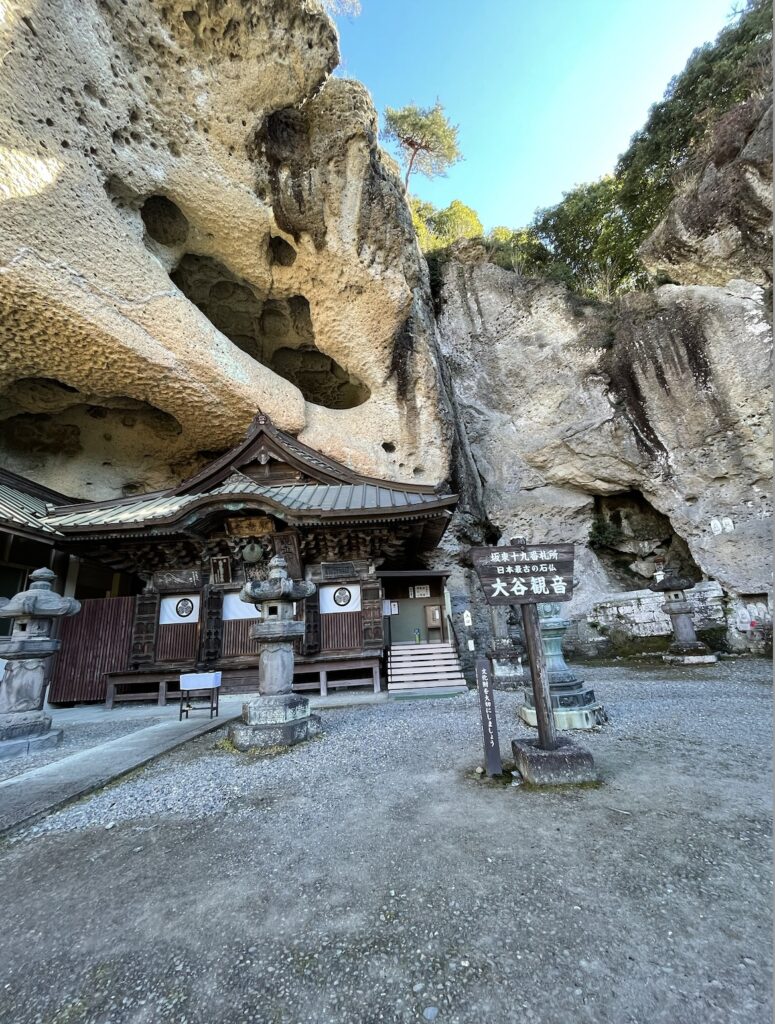
I keep walking until I see a small car park. Next to it is the Ooya-ji temple. It is small and unassuming and I confess I can’t see what the fuss is all about. I pay the entrance fee and read the English version of the brochure.
Oldest stone statue of the Buddha in Japan
Only now do I realise the significance of this place and why the train station guard encouraged me to come here. Inside this temple is the oldest stone statue of the Buddha in Japan, dating back more than 1,200 years.
I turn my phone to silent and walk in softly, reverentially. I enter through a small temple building, which is tucked in at the base of the cliff. Here, an official points at my camera and tells me photography is forbidden. I bow in acknowledgement. The official – less officiously this time – also tells me to join my hands when I am in front of the statue and pray for world peace. I promise to do so. Goodness me, do we need that!
I follow a walkway under the cliff’s overhang, coming face to face with a number of statues carved into the cave wall. Because of the almost 45 degree angle of the wall here, the statues partially look down on you, making the experience even more remarkable and making you feel very small.
The main statue – Senju Kannon – is mesmerising. It’s four metres high and has more than 30 arms spread out in a fan. Apparently each hand had an eye carved into it, ensuring the Buddha could watch over and care for everyone. They have been worn off over the centuries but that decay takes nothing away from this incredible piece of art. Senju Kannon is at once alarming and magnificent.
It is said to have been carved in the Hei-an period, around the year 810. The surface – according to the brochure – was originally lacquered and covered with gold leaf. So this masterpiece must have shone the golden light of the Buddha on the faces of every devotee who visited. What an experience that must have been.
But even seeing the statute today – plain stone, eroded and faded as it is – is a massive and totally unexpected thrill.
© copyright Matthew Brace