
Episode summary:
I drove a truly breathtaking road in far north Norway, more than 300km above the Arctic Circle. It is probably the most thrilling road I have ever driven and had me gasping in wonder and staring open-mouthed and speechless.
The road hugged the coastline, cruised around headlands and skirted placid bays, whose shoreline meadows were strewn with wild flowers. The crinkly coastline harbours the most northerly of Norway’s fjords and this road lets you drive right through them.
If you are wondering ‘what is the most scenic road in Norway’, ‘is Alta, Norway worth visiting’, or ‘what is the most beautiful road trip in Norway’, then this Arctic episode might help.
Listen to a podcast about driving a stunning Arctic road in Norway.
Transcript – S5 E3: Driving a stunning Arctic highway
This week we’re driving a truly breathtaking road way above the Arctic Circle.
The term ‘E6’ doesn’t sound like much. It could be a ward in a hospital or a characterless classroom.
But if you are lucky enough to find yourself in the far north of Norway, it should fill you with nothing but unadulterated joy. Because ‘E6’ here is a road of quite staggering beauty. A road that delivers breathtaking views around almost every corner. A road that will have you gasping in wonder and staring open-mouthed and speechless.
It’s really not fair for one road to be so perfect. Even the movie-set-ready Joshua Tree Highway in California, the dramatic Great Ocean Road in Australia and Scotland’s glorious A87 from the Isle of Skye to Loch Ness have a few dull bits in them. But the E6 doesn’t seem to have any at all!
A road above all others
It starts way east, at the Barents Sea port of Kirkenes, little more than a snowball’s throw from the Russian border. It motors west, following the coastline, then south along Norway’s border with Finland. It ticks up north again across dramatic tundra to the pretty town of Olderfjord, before heading south west to the Norwegian Sea port of Alta. Its route so far has all been conducted more than 300km or 185 miles above the Arctic Circle. This is proper north.
I pick it up in Olderfjord and enjoy its stunning vistas and watching herds of reindeer cross it nonchalantly on an early summer afternoon. What I don’t realise is that the E6 is just warming up. South of Alta it is positively mesmeric. This crinkly coastline harbours the most northerly of Norway’s fjords and the E6 lets you drive right through them.
The road hugs the coastline, cruising around headlands and skirting placid bays, whose shoreline meadows are strewn with wild flowers. When the grey granite buttresses of the headlands are too challenging, it turns inland slightly and powers through the best-swept and best-lit road tunnels I have ever seen. It’s like they were opened yesterday.
Is this Europe’s most photogenic road?
From each one I burst back out into the light and am met with an impossibly beautiful vista. Layers of mountains more numerous than Tolkien’s peaks of Mordor, yet infinitely more inviting. The closest ones are coal black against the sun, while those further away are a little lighter and hazier. One or two still have winter snow on their highest reaches.
I don’t know where to look first. Luckily the traffic is negligible today because I stop every few kilometres and leap from the car to train my lens on these perfect mountains. I know, though, that no photograph, no matter how well cropped and joojed, is going to be anywhere near as dazzling as the actual scene.
I drive down Langfjord, through the tiny settlement of Alteidet where a small river forms a muddy delta as it issues into Litt-le Altafjorden.
The E6 takes me south along the eastern shoreline of an inlet called Buvrovunta to the regional town of Burfjord and beyond. I do hope I am getting these names right. I drive through stands of lime-green birch trees to the Sorrstaumen Bridge which towers over a crystal-clear tidal river that is racing back into the Norwegian Sea, bending double the submerged miniature forests of seaweed as it does so.
A beatific view of the Lyngen Alps
At one point I nearly drive off the road. I’m near Rotsund, which is little more than a small jetty from where ferries cross the fjord to the even more remote settlements of Hammnes and Uloybukt. I have to stop. I find a convenient gravel turnout next to what looks like an abandoned fishing warehouse.
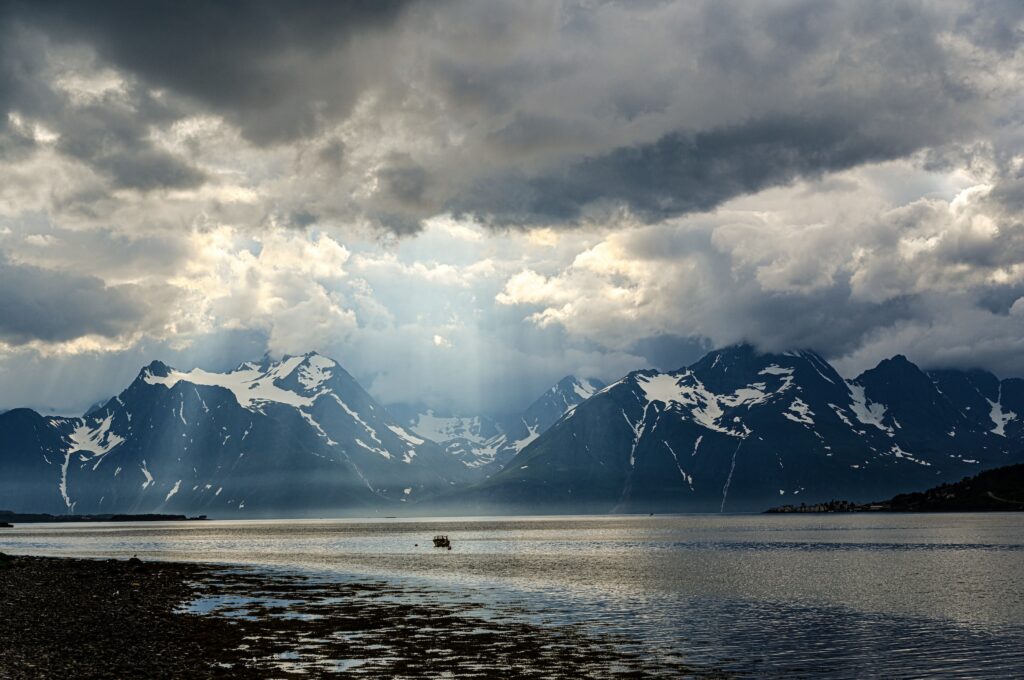
I am looking due west. To my right the silhouetted slopes of the island of Uloya rise. Immediately in front of me are the still waters of the fjord, their blue-silver sheen broken only by a small patch of seagrass near the shoreline and a lone fishing boat out in the middle of the fjord.
In the background, across the Lyngen Fjord are the Lyngen Alps on the north-south peninsula of the same name. Somewhere up there are more than 130 glaciers and I think I can pick out a couple among the patches of snow up on the peaks.
The scene ramps up from amazing to positively beatific as there is a break in the cloud above the Alps and sunlight pours down, spreading into a giant fan of crepuscular rays.
This is sheer natural Nordic beauty and for the hour I spend here I am utterly immersed in its splendour.