
Taj Mahal, Agra, India. © copyright Matthew Brace
Episode summary:
I spent several hours relaxing on the banks of the sacred Yamuna River near the mighty Taj Mahal in northern India. The Taj Mahal is an incredible building and a worthy UNESCO World Heritage Site but its gardens and the river that glides past it are, in my view, equally as enchanting.
If you are wondering ‘what’s so special about the Taj Mahal’, ‘is it worth it to go to the Taj Mahal’, ‘what is special about Yamuna River’ or ‘can I see peacocks at the Taj Mahal’, this podcast might help.
Listen to a podcast about finding peace on the banks of the sacred Yamuna River in India.
Transcript – S5 E6: Peace on an Indian sacred river
This week we’re ‘taking five’ on the banks of a holy river in northern India.
The Yamuna River is one of many tributaries that feed the mighty Ganges. It’s the longest and if measured by discharge – or the billions of tonnes of water it adds to its sister river – it’s the second biggest.
It begins life as little more than a trickle about 14,800ft (or 4,500m) up in the Himalayas, as meltwater from the Yamunotri Glacier. It flows through the state of Uttarakhand and past numerous shrines built for devotion to the Hindu Goddess for whom the river is named. This river is sacred.
It is joined by numerous other streams and rivers on its journey south, getting fatter and slower before thinning out temporarily after first a dam and then a barrage. Once down on the flat expanses south of the mountains it saunters along, marking a loose border between the states of Haryana and Uttar Pradesh, and right past the battlements of the Red Fort in Delhi.
Reaching the Taj Mahal
Further south and east it makes giant intestinal loops north of the city of Agra before flowing gracefully past my feet – here, today, at the Taj Mahal.
I love the architecture and incredibly intricate art and design work of the Taj Mahal and I love the story behind it too – a resting place for the body of Mumtaz Mahal, the wife of the fifth Mughal Emperor, Shah Jahan. But I love the natural environment here even more. The gardens – created just a few years after the building was finished in the 17th century – are stunning and kept immaculately neat and tidy by an army of lawn mowers, hedge trimmers and flower pruners. Originally – historians believe – these gardens would have been awash with roses and fruit trees. Today there are echoes of these but such plants are a little less abundant and the gardens are a little more formal perhaps.
A natural wonder
To us humans this is a UNESCO World Heritage Site with super-Instagrammable backdrops, but to birds and wildlife it’s a vital sanctuary – a great swathe of green in an often dry part of India. Here birds can find all the things they need for survival – food, water and protection for breeding and nesting. Some live here year-round; others fly in to escape colder, less-hospitable winters further north.
The star of the show must be the resplendent peacock, India’s national bird. Its dazzling colours, the intense intricacy of its feather designs and its sheer all-round glamour all still amaze me. As I walk through the grounds today I hear several peacocks before I see them, their unique calls echoing around the woods and through the cloisters of the Taj’s neighbouring building, the Mehman Khana. To me it is one of the quintessential sounds of India.
In the tops of some trees I see small flocks of rose-ringed parakeets gorging on fruit and squabbling with the ever-present myna birds. I follow a path through the trees that takes me to the river, where I find a quiet spot to sit, watch the water and let the natural scene envelop me.
On the banks of the lazy river
It’s dry season but the water level is still pretty good – lower than in the monsoon but still covering a good two thirds of the channel… I’m guessing a width of more than 100ft or 30m. White-throated kingfishers frequent this stretch of the Yaumuna, plummeting beneath the surface in search of a fish supper. I watch for them but I never seem to have much luck with kingfishers – whether I’m in Agra, Australia or Arkansas – and today is no exception.
I do see a big bird land at the water’s edge on the northern side of the river, however, but it’s too far off for me to make a positive identification. A heron, perhaps?
Anyway, it’s just lovely to be here, even without the presence of a white-throated kingfisher. The scene is so therapeutic, so relaxing. India – wonderful as it is – can be exhausting but there are still natural spots like this reminding visitors that this country has as much tranquillity as chaos.
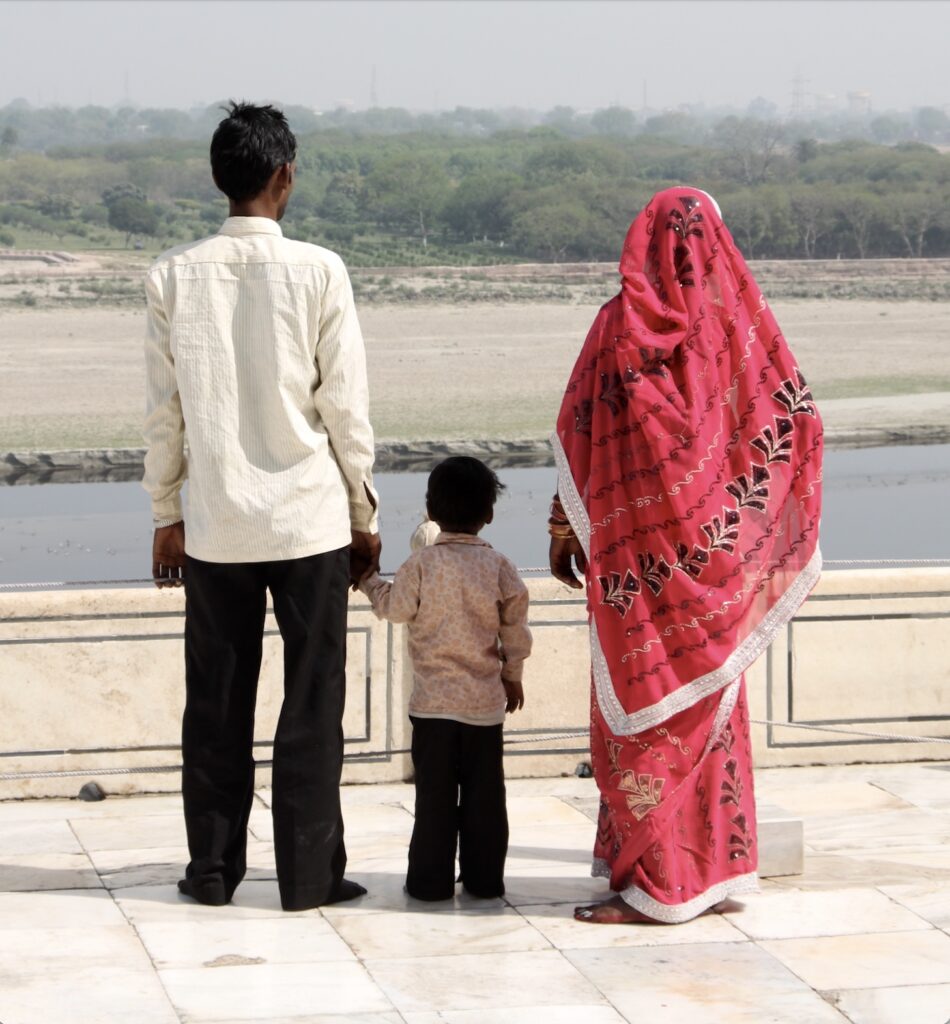
A family stands a short distance off – a man in a white shirt and dark trousers, a woman in dazzling pink and between them a small child dressed in his Sunday best. Together – but at the same time, not together – we watch the scene. They too are enjoying a break from the noise and bustle of daily life – a chance to think, to be at one with nature, and to feel the spirituality of this sacred river.