
Saving Scotland’s Red Squirrels partnership
Episode summary:
I had a thrilling encounter in the Scottish Highlands with a remarkable red squirrel. It’s not just its beauty and playful behaviour that are so amazing – this animal also has a miraculous story to tell.
Populations in the UK have declined by as much as 90% over the past 150 years but a courageous fightback is underway, spearheaded by partnerships such as Saving Scotland’s Red Squirrels. Dedicated work by volunteers, wildlife groups and charities such as the Scottish Wildlife Trust means the red is making a comeback – and it’s a sight to see!
If you are wondering ‘is it rare to see a red squirrel’, ‘why are red squirrels endangered’ or ‘where is the best place to see red squirrels in Scotland’, this podcast episode might help. And if you’re in Scotland why not lend a hand by reporting your sightings on the Saving Scotland’s Red Squirrels website.
Listen to a podcast about the joy and wonder of seeing a red squirrel up close.
Transcript – S5 E7: Scotland’s remarkable red squirrels
This week we’re frolicking in the Scottish Highlands with some loveable creatures who have a miraculous story to tell.
You never forget seeing your first red squirrel. You might wait for hours by the side of a loch swathed in netting to keep off the midges. You might be a trifle damp and chilly after sitting in soft Scottish rain. But when the first one comes into view, your eyes will widen and your heart will race.
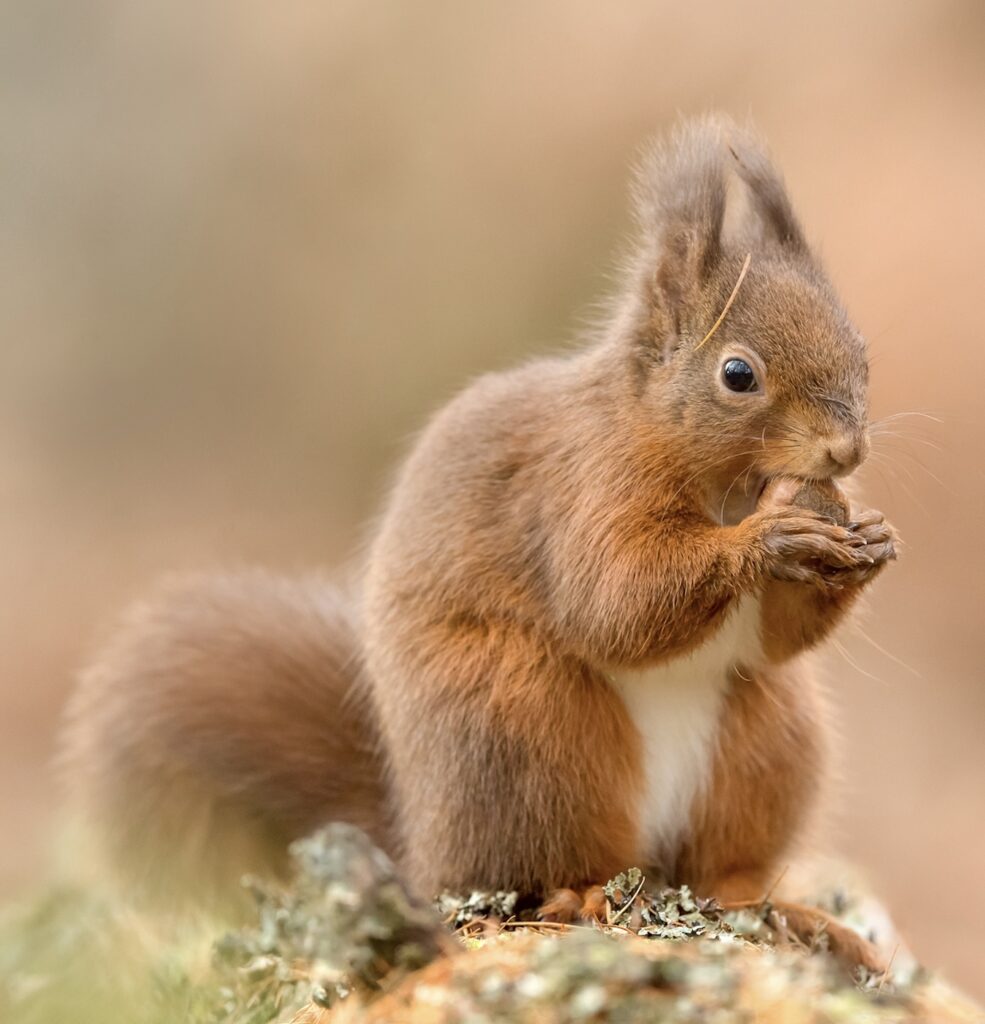
The red squirrel is adorable. It is a vivid fluffball of colour that appears suddenly, shines brightly and then is gone again, always on the move, always busy. In shade it looks as if it has been rolling around in cinnamon dust but when the sunlight hits its coat it turns it to a brilliant mix of copper and ginger.
Because its natural habitat is pine forest, you are likely to see one against a relatively uniform backdrop of grey tree bark and dark-green pine needles. This makes it stand out even more. If you are super lucky you might see two of them chasing each other up or down a tree trunk, round and round, with their big bushy tails flashing behind them.
That’s when you can really get a sense of their arboreal agility and dexterity. They are perfectly at home upside down and 100ft up a tree, leaping from branch to branch.
Not just a pretty face
The thrill of seeing a red squirrel is accentuated even more when you know their remarkable story of survival. Populations here in the UK have suffered critical declines over the last 150 years, plummeting as much as 90%.
According to the Scottish Wildlife Trust the decline has been primarily due to competition for food and living space from the invasive, non-native, American grey squirrel. Grey squirrels also carry Squirrelpox, a virus that is lethal to reds but not to greys. At about the same time the greys were being introduced – in the late 19th century – the reds – if you can believe it – were being hunted in their thousands for their tails.
That there are any reds left at all in the UK is a miracle and the species’ sheer determination is partly why it has gone into Scottish folklore as a symbol of resilience.
The red’s recovery has only been possible thanks to incredible efforts by organisations such as the Scottish Wildlife Trust. The Trust continues to lead a major partnership called Saving Scotland’s Red Squirrels to protect and preserve this wonderful animal. Of today’s population of 287,000, about 83% are in Scotland, with the remainder in northern England, Wales and Northern Ireland.
The big red comeback
Possibly the biggest success story has been in Aberdeenshire, in north east Scotland, where the partnership has worked with councils, volunteers and residents to remove grey squirrels. It’s been a fabulous success with red squirrels now seen all across the region, and many even returning to gardens in the city of Aberdeen.
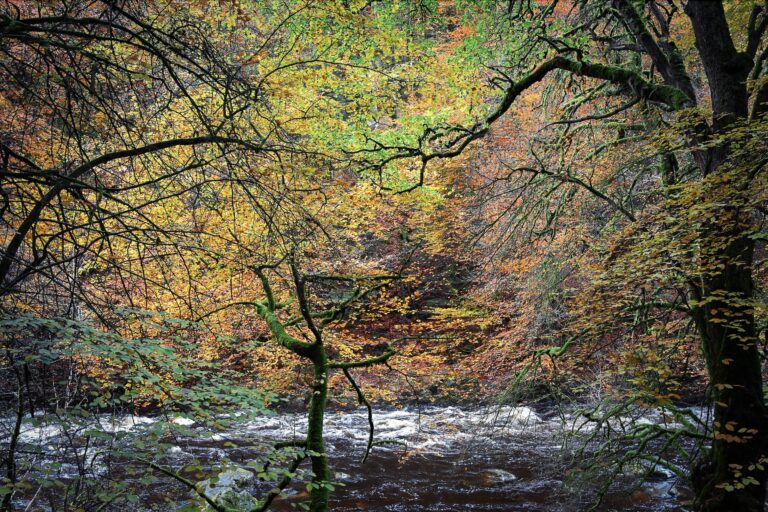
I am looking at a result of this miraculous recovery right now, about a two-hour drive south-west of Aberdeen, in the wooded grounds of the Dunkeld House Hotel in Perthshire, the gateway to the Scottish Highlands. I am strolling through an autumn carpet of rust and ochre leaves along the banks of the River Tay to the Atholl Arms in the small town of Dunkeld, where I am meeting some friends for an evening of single malt whisky tasting. Single malt whisky tasting is, I confess, one of my favourite activities but I would forego it in a heartbeat if the alternative was seeing a red squirrel in its natural habitat.
Memorable nature moment in the Scottish Highlands
And to my complete and utter delight, I spot one. I hear a scratching, close by, about 30ft up a tree. Whatever is doing the scratching is doing it on the other side of the tree. I wait, holding my breath and – in a few seconds – a copper-coloured fuzzball scampers round the trunk and looks straight at me with dark, intense eyes. I see its characteristic ear tufts, which grow at this time of year and are present throughout winter.
My phone’s in my back pocket and I know if I reach for it to try to get a photo, I’ll spook the squirrel and it will disappear. So I freeze… and watch. It looks down the tree, then up, then back at me and then straight ahead. Ever alert. I am in the presence of a small but very important, very brave and truly beautiful animal.
The autumn dusk has already begun, so I am losing light quite fast. There’s no chance of any sunlight illuminating the squirrel but it’s still a wonderful sight. With a rapid movement, it changes position and points up the tree, letting me see its tail in all its gingery glory. More quick glances left and right and then it shoots up the trunk, defying gravity as it bounds up and up, before coming to rest on a branch and looking down at me as if to say: “impressive, eh?”
It then does the entire trip in reverse, scampering down and down right to the ground, where it sits up and has a quick face wash before hopping through the leaves – which provide excellent camouflage – to an adjacent fir tree and zooming up it and disappearing into the topmost branches.
I’m running late for the whisky tasting now but even a tempting array of Scotland’s finest malts couldn’t tear me away from this experience.